

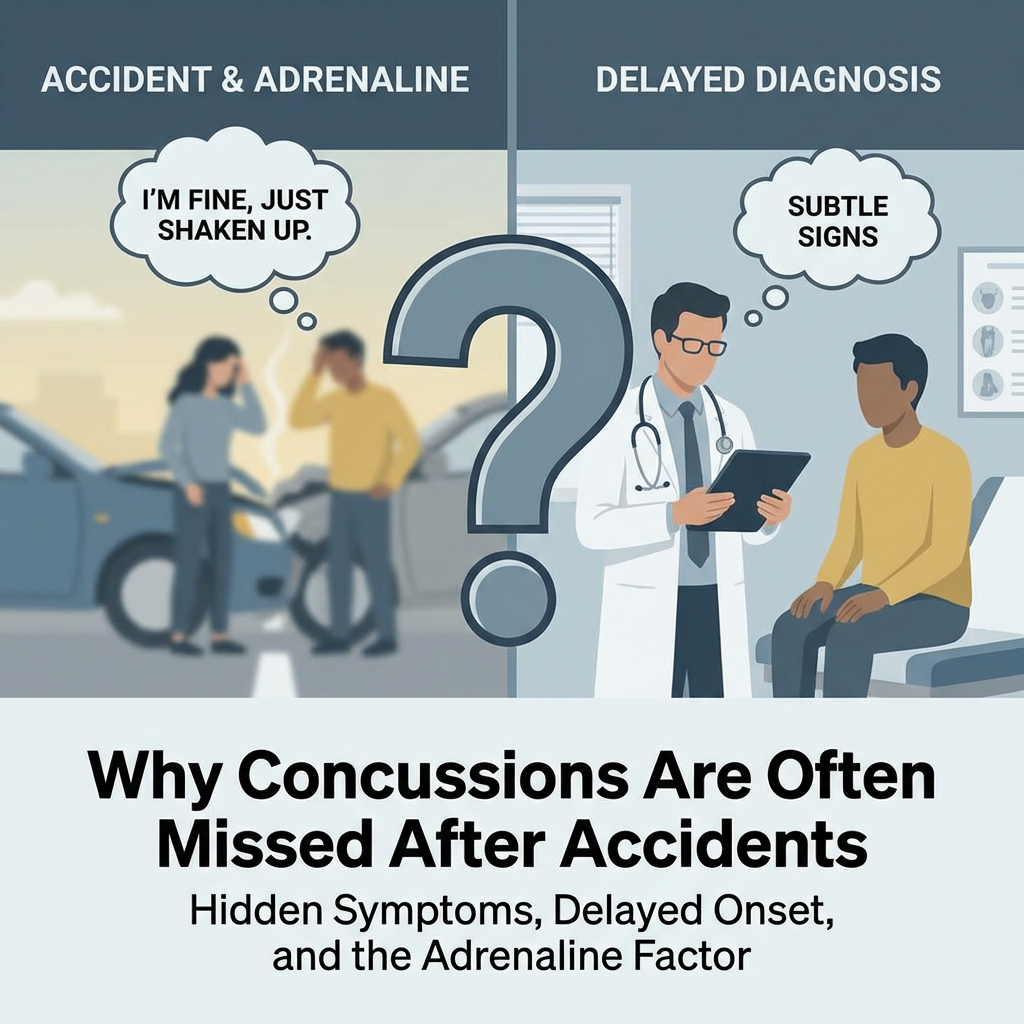
Why Concussions Are Often Missed After Accidents
When most people think of serious accident injuries, they imagine:
-
Broken bones
-
Surgery
-
Visible trauma
But one of the most commonly overlooked — and most misunderstood — injuries after a car accident is a concussion.
Concussions are often missed.
Not because they aren’t serious.
But because their symptoms can be subtle, delayed, and difficult to measure.
And when they are missed early, both medical recovery and injury claims can become more complicated.
Understanding why concussions are frequently overlooked can help accident victims recognize symptoms sooner and avoid mistakes that reduce leverage later.
What Is a Concussion?
A concussion is a mild traumatic brain injury (mTBI).
It occurs when the brain experiences a sudden acceleration or deceleration force, causing it to shift within the skull.
This can happen:
-
Even without hitting your head
-
Even without losing consciousness
-
Even in relatively low-speed crashes
The force of impact alone can disrupt brain function temporarily — and sometimes longer.
Concussions affect brain chemistry and neurological function, not just structure.
That distinction is critical.
Why Concussions Are Frequently Missed
There are several reasons concussions are commonly overlooked after car accidents.
1️⃣ There Is Often No Visible Injury
Unlike cuts or fractures, concussions do not show external signs.
No bleeding.
No obvious swelling.
No visible deformity.
Because the injury is internal and neurological, it may not be immediately obvious to the injured person — or even to first responders.
2️⃣ Loss of Consciousness Is Not Required
Many people believe:
“If I didn’t black out, I don’t have a concussion.”
That’s incorrect.
Most concussions do not involve loss of consciousness.
You can:
-
Remain alert
-
Walk away from the crash
-
Speak normally
-
Feel “shaken up”
And still have a concussion.
This myth leads many people to underestimate the injury early.
3️⃣ Symptoms Can Be Delayed
Concussion symptoms often appear gradually.
You may not notice issues until:
-
Hours later
-
The next day
-
Several days after the crash
Common delayed symptoms include:
-
Headaches
-
Dizziness
-
Nausea
-
Light sensitivity
-
Sound sensitivity
-
Fatigue
-
Brain fog
-
Memory issues
-
Irritability
-
Difficulty concentrating
-
Sleep disruption
Because symptoms evolve, many accident victims initially tell insurance adjusters:
-
“I feel okay.”
-
“I’m just a little sore.”
-
“It’s probably nothing.”
That early minimization can later complicate claim evaluation.
4️⃣ CT Scans Often Appear Normal
In emergency settings, doctors often order CT scans to rule out:
-
Brain bleeding
-
Skull fractures
-
Acute trauma
CT scans are excellent for detecting life-threatening injuries.
But concussions frequently do not appear on CT scans.
The absence of visible findings does not mean the brain was not injured.
Concussions affect function more than structure.
Insurance companies sometimes rely heavily on “normal imaging” to question severity.
How Concussions Affect Daily Life
Because concussions are neurological injuries, they affect:
-
Focus
-
Memory
-
Mood
-
Sleep
-
Energy levels
-
Work performance
-
Emotional regulation
Symptoms may interfere with:
-
Reading
-
Screen time
-
Driving
-
Work productivity
-
Physical activity
-
Household responsibilities
These disruptions are often invisible to others — which can make them harder to validate and document.
Why Insurance Companies Often Scrutinize Concussion Claims
Concussions are frequently challenged for several reasons:
1️⃣ Symptoms Are Subjective
Headaches.
Fatigue.
Brain fog.
Concentration problems.
These symptoms rely heavily on patient reporting.
Unlike fractures or visible injuries, there may not be dramatic objective findings.
Insurance companies often favor injuries that show clearly on imaging.
When symptoms are neurological and subtle, scrutiny increases.
2️⃣ No Loss of Consciousness Argument
Adjusters may argue:
-
“You didn’t lose consciousness.”
-
“You were alert at the scene.”
-
“The ER discharged you quickly.”
These facts do not rule out concussion — but they are often used to minimize it.
3️⃣ Symptoms Overlap With Stress
After an accident, people experience:
-
Anxiety
-
Shock
-
Sleep disruption
-
Emotional distress
Some concussion symptoms overlap with stress reactions.
Insurance companies may argue symptoms are emotional rather than neurological.
That distinction can influence claim value significantly.
Why Early Documentation Matters in Concussion Cases
Because concussions are often subtle, documentation becomes critical.
Medical records should reflect:
-
When symptoms began
-
How symptoms progressed
-
Cognitive complaints
-
Work restrictions
-
Functional limitations
-
Referral to specialists if needed
Consistency in reporting symptoms strengthens credibility.
Gaps or inconsistencies weaken valuation.
As explained in How Insurance Companies Decide What Your Case Is Worth, documentation quality directly influences settlement range.
Post-Concussion Syndrome
In some cases, symptoms persist beyond a few weeks.
This may be referred to as post-concussion syndrome.
Symptoms may include:
-
Persistent headaches
-
Ongoing cognitive fog
-
Memory difficulty
-
Sleep disturbance
-
Mood changes
-
Light sensitivity
When symptoms persist, treatment may involve:
-
Neurology evaluation
-
Neuropsychological testing
-
Vestibular therapy
-
Cognitive rehabilitation
-
Medication management
These cases carry higher exposure — and often higher resistance from insurers.
Why Concussions Can Become High-Value Claims
Concussions can impact:
-
Employment capacity
-
Cognitive function
-
Career trajectory
-
Daily life functioning
-
Emotional stability
Because brain injuries affect thinking and processing, long-term consequences can be significant.
Insurance companies evaluate:
-
Duration of symptoms
-
Specialist involvement
-
Objective testing
-
Work impact
-
Treatment consistency
-
Litigation risk
When well-documented, concussion claims can carry substantial weight.
When poorly documented, they are often minimized.
The Role of IMEs in Concussion Cases
Insurance companies frequently request Independent Medical Exams in concussion cases.
IME doctors may:
-
Question symptom validity
-
Attribute symptoms to stress
-
Emphasize normal imaging
-
Minimize duration
Understanding the strategic role of IMEs — discussed in The Truth About Independent Medical Exams (IMEs) — helps explain why concussion cases are often contested.
The Biggest Mistake After a Possible Concussion
The most common mistake is ignoring symptoms early.
Many people:
-
Assume headaches will resolve
-
Minimize dizziness
-
Push through fatigue
-
Continue working without evaluation
-
Fail to report cognitive issues
Early underreporting creates documentation gaps.
Documentation gaps weaken leverage later.
Concussion claims are particularly sensitive to early records.
The Takeaway
Concussions are often missed after accidents because:
-
There may be no visible injury
-
Loss of consciousness is not required
-
Symptoms can be delayed
-
CT scans often appear normal
-
Symptoms are subjective
-
Effects overlap with stress reactions
But concussions are real neurological injuries.
They affect brain function — not just comfort.
Proper evaluation, consistent documentation, and early recognition are critical.
If you want to understand how different injuries affect claim evaluation more broadly, visit:
Common Accident Injuries & Claims
Because when it comes to brain injuries, early awareness makes a significant difference — both medically and strategically.