

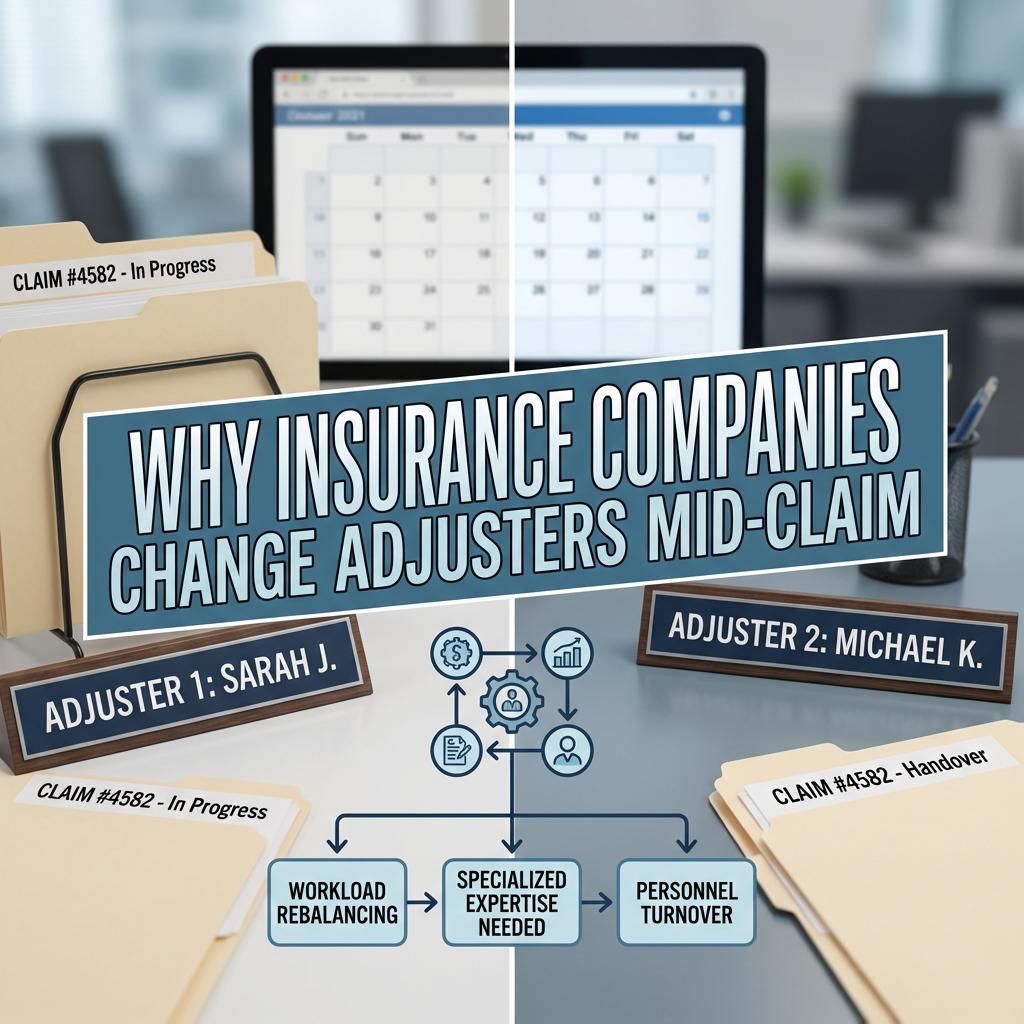
Why Insurance Companies Change Adjusters Mid-Claim
One day you’re speaking with one adjuster.
The next day you receive an email:
“Your claim has been reassigned.”
For many accident victims, that moment feels unsettling.
-
Is something wrong?
-
Are they stalling?
-
Did the case get worse?
-
Is this a tactic?
Sometimes it’s strategic.
Sometimes it’s administrative.
But in injury claims, adjuster changes are not uncommon — especially as cases evolve.
Understanding why insurance companies change adjusters helps remove uncertainty and restore clarity.
Adjuster Assignments Are Tiered
Most insurance companies use tiered claim systems.
Claims are often assigned based on:
-
Injury severity
-
Medical exposure
-
Policy limits
-
Complexity
-
Litigation risk
Early in a claim, it may be assigned to a:
-
General liability adjuster
-
Entry-level bodily injury adjuster
-
Fast-track resolution unit
If the case develops — extended treatment, higher bills, specialist referrals — it may be reassigned to:
-
A senior adjuster
-
A complex injury unit
-
A litigation unit
-
A large-loss division
Reassignment doesn’t automatically mean trouble.
It often reflects exposure growth.
Claims That Increase in Value Often Move “Upward”
In many cases I’ve reviewed, adjuster reassignment happens when:
-
Treatment extends beyond initial expectations.
-
Imaging reveals structural injury.
-
Surgery becomes possible.
-
Wage loss increases.
-
A lawyer becomes involved.
-
Settlement discussions escalate.
As exposure increases, insurers shift files to more experienced adjusters.
Higher-value claims receive higher-level oversight.
This is structural — not emotional.
Litigation Preparation Units
If a case approaches potential litigation, insurers often transfer the claim to:
-
Litigation specialists
-
Trial preparation teams
-
Defense counsel liaison adjusters
These adjusters are trained to:
-
Evaluate jury risk
-
Coordinate with defense attorneys
-
Review medical documentation closely
-
Analyze causation in detail
-
Assess reserve adequacy
When this happens, scrutiny typically increases.
But so does internal risk awareness.
Administrative Reassignments
Not all adjuster changes are strategic.
Adjusters:
-
Change departments
-
Take leave
-
Transfer offices
-
Leave the company
-
Receive caseload redistribution
Insurance companies are large operations.
Reassignment may simply reflect staffing shifts.
In practice, some reassignments are routine workload balancing.
Why Reassignment Can Feel Like a Delay
When a new adjuster takes over, they often:
-
Re-review the file
-
Re-read medical records
-
Reassess liability
-
Confirm documentation
-
Reevaluate reserves
That re-evaluation period can feel like a slowdown.
But from the insurer’s perspective, new adjusters are responsible for independently assessing exposure.
This may create temporary pauses in negotiation.
Reserve Reassessment
Insurance companies set internal reserves — projected payout estimates — early in a claim.
When exposure changes, reserves may be adjusted.
Adjuster reassignment sometimes occurs when:
-
Reserve increases are required
-
Large-loss thresholds are triggered
-
Supervisory review is mandated
-
Escalation approval is needed
Reserve increases often require higher-level oversight.
Reassignment may accompany that process.
Does Reassignment Mean the Case Is Weak?
Not necessarily.
In fact, some of the strongest claims are reassigned precisely because:
-
Exposure increased
-
Medical documentation strengthened
-
Treatment extended
-
Risk grew
-
Litigation probability rose
Stronger cases often move to more senior adjusters.
Reassignment alone does not indicate weakness.
When Reassignment Signals Increased Scrutiny
That said, reassignment can also signal:
-
Causation concerns
-
Documentation inconsistencies
-
Surveillance consideration
-
IME scheduling
-
High-value exposure review
As cases grow in complexity, scrutiny increases.
Insurance companies rarely leave higher-exposure claims at entry-level review.
The Psychological Impact
For many people, adjuster reassignment feels destabilizing.
It interrupts rapport.
It resets communication.
It introduces uncertainty.
But it’s important to understand:
Adjusters represent the insurer — not the claimant.
Rapport does not equal advocacy.
Structural exposure drives assignment decisions.
Why Representation Often Triggers Reassignment
When legal counsel enters a claim, reassignment is common.
Insurance companies may transfer the file to:
-
Attorney-handling units
-
Litigation specialists
-
Senior adjusters
-
Complex claim teams
This is because representation changes litigation risk.
As discussed in When Is the Right Time to Hire a Personal Injury Lawyer?, legal involvement shifts structural leverage.
Adjuster reassignment often reflects that shift.
Reassignment and Settlement Negotiation
When a new adjuster takes over:
-
They may reset negotiation posture.
-
Prior informal discussions may be revisited.
-
Settlement ranges may be re-evaluated.
-
Documentation may be scrutinized again.
In some cases, reassignment leads to:
-
Increased offers (if exposure grew).
-
More resistance (if scrutiny intensified).
-
Delayed responses during review.
The direction depends on file strength.
The Experience Pattern
Over time, a consistent pattern emerges:
Claims that evolve — medically or strategically — often evolve administratively.
Adjuster reassignment usually tracks exposure.
When treatment expands, oversight expands.
When risk increases, scrutiny increases.
When litigation becomes possible, file control tightens.
Reassignment is usually about risk recalibration.
What Should You Do If Your Adjuster Changes?
Generally:
-
Remain consistent in communication.
-
Avoid changing your narrative.
-
Continue treatment as directed.
-
Maintain documentation discipline.
-
Do not assume hostility.
-
Do not panic.
Structural changes inside insurance companies are common.
Your role is consistency.
Consistency preserves credibility.
The Bigger Perspective
Insurance companies operate on layered risk systems.
Adjusters are assigned based on:
-
Claim value
-
Complexity
-
Risk exposure
-
Litigation probability
-
Supervisory requirements
Reassignment reflects internal structure — not personal dynamics.
Understanding that prevents overreaction.
In injury claims, emotional responses rarely strengthen leverage.
Structural consistency does.
The Takeaway
Insurance companies change adjusters mid-claim because:
-
Exposure increased
-
Injury severity evolved
-
Litigation risk rose
-
Reserves required adjustment
-
Representation entered
-
Supervisory oversight was triggered
-
Administrative workload shifted
Reassignment does not automatically signal:
-
Weakness
-
Denial
-
Hostility
-
Collapse
It signals recalibration.
In injury claims, recalibration usually follows exposure growth.
And exposure growth often reflects case development.
Understanding that dynamic helps maintain clarity when internal insurer processes shift.