

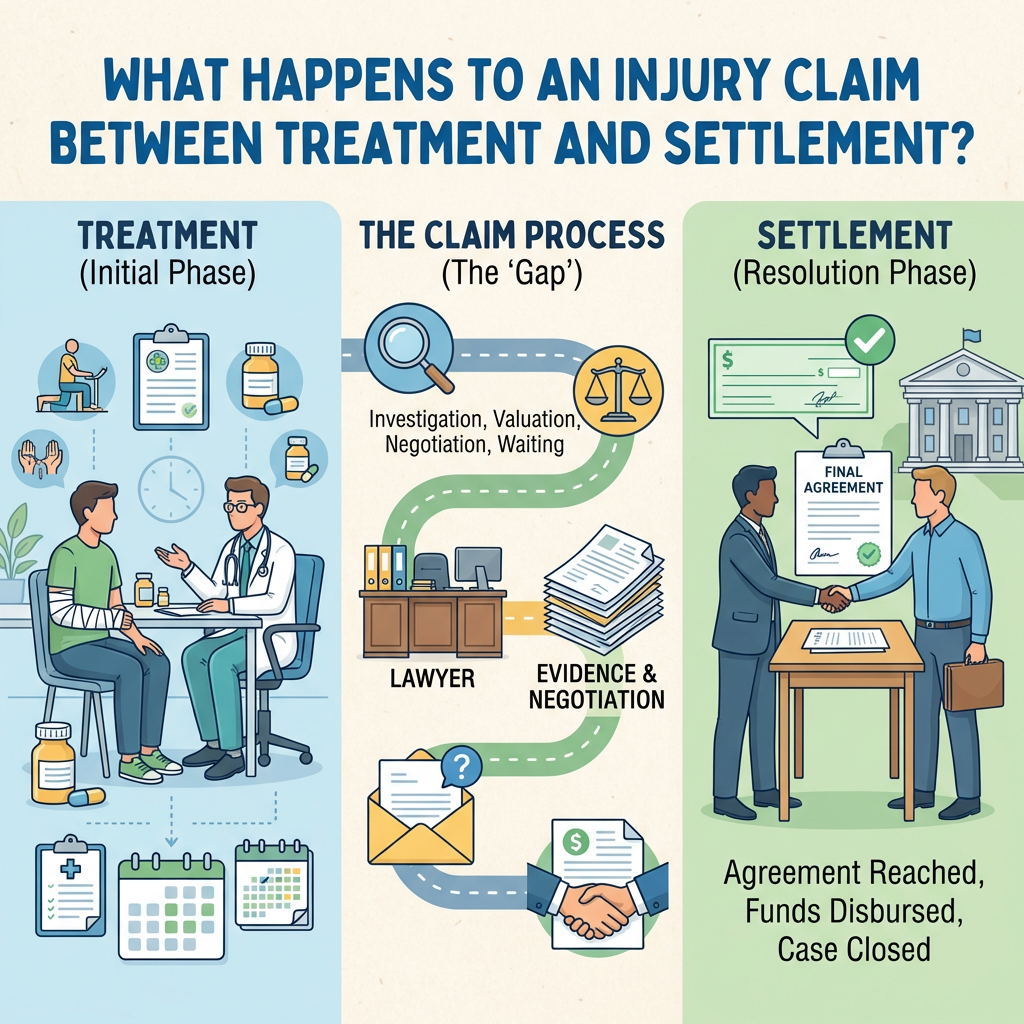
What Happens to an Injury Claim Between Treatment and Settlement?
Many people understand the beginning of an injury claim.
There’s an accident.
Medical treatment begins.
Insurance companies are notified.
But what happens after treatment — and before settlement — is often unclear.
This middle phase can feel slow, uncertain, and confusing.
You may finish physical therapy.
You may stop seeing specialists.
Symptoms may stabilize.
Then… nothing seems to happen.
Understanding what occurs during this phase helps clarify why settlement is rarely immediate and why structure matters more than speed.
Step One: Medical Stabilization
Insurance companies generally prefer to evaluate claims after the medical picture stabilizes.
This does not always mean full recovery.
It often means:
-
Treatment has concluded or plateaued.
-
Maximum medical improvement (MMI) is reached.
-
Future care needs are identified.
-
Permanent impairment (if any) is documented.
Settling before stabilization creates risk.
If symptoms worsen later, reopening a settled claim is typically not possible.
That is why timing matters.
Step Two: Gathering Complete Medical Records
After treatment concludes, records must be collected.
This includes:
-
Emergency room records.
-
Primary care notes.
-
Specialist evaluations.
-
Imaging reports.
-
Physical therapy records.
-
Surgical reports (if applicable).
-
Billing statements.
Medical providers often take weeks to respond.
Incomplete records slow evaluation.
Insurance companies require full documentation before serious settlement discussion.
Step Three: Organizing the Narrative
Medical records alone do not tell a clean story.
They must be organized into a coherent timeline:
-
Date of accident.
-
First report of symptoms.
-
Diagnostic testing.
-
Treatment progression.
-
Response to treatment.
-
Ongoing limitations.
-
Prognosis.
Consistency across providers is crucial.
If records conflict or contain gaps, insurers may focus on those inconsistencies.
As discussed in How Insurance Companies Decide What Your Case Is Worth, documentation strength influences exposure modeling.
Step Four: Evaluating Damages Categories
During this middle phase, damages are assessed.
This includes:
-
Medical expenses (past).
-
Medical expenses (future, if applicable).
-
Lost wages.
-
Loss of earning capacity.
-
Pain and suffering.
-
Loss of enjoyment of life.
Each category must be documented.
Lost wages require employer verification.
Future care may require medical opinion.
Pain and suffering requires narrative consistency.
Nothing is assumed.
Everything is evaluated.
Step Five: Internal Insurance Review
Once documentation is submitted, insurers conduct internal review.
This may include:
-
Adjuster evaluation.
-
Supervisory review.
-
Reserve reassessment.
-
Legal consultation (in higher exposure cases).
-
Risk modeling.
During this stage, communication may slow.
As explained in Why Insurance Companies Stall Settlement Negotiations, delays often reflect internal review — not necessarily rejection.
Higher-value claims often require higher-level approval.
Approval takes time.
Step Six: Demand and Counteroffer
When the claim is fully documented, settlement discussions begin.
Typically:
-
A demand package is submitted.
-
The insurer reviews and evaluates.
-
An initial offer is made.
-
Negotiation follows.
Initial offers are often conservative.
Not because the insurer denies injury.
But because negotiation strategy assumes movement.
This stage may involve:
-
Requests for clarification.
-
Questions about prior injuries.
-
Challenges to treatment duration.
-
Disputes over future care projections.
Negotiation is rarely a single exchange.
It is a structured process.
Step Seven: Assessing Litigation Probability
If negotiations stall or offers remain unreasonably low, litigation risk becomes a factor.
Insurance companies evaluate:
-
Liability strength.
-
Injury severity.
-
Documentation clarity.
-
Venue characteristics.
-
Jury tendencies.
-
Defense costs.
-
Attorney reputation.
As discussed in What Does a Personal Injury Lawyer Actually Do After You Hire Them?, representation influences how insurers assess litigation probability.
Litigation does not always occur.
But its possibility influences evaluation.
Why This Phase Feels Slow
This middle stage often feels like nothing is happening.
In reality:
-
Records are being reviewed.
-
Exposure is being calculated.
-
Reserves are being adjusted.
-
Supervisors are approving authority.
-
Legal opinions are being sought.
Insurance companies move deliberately when exposure increases.
Speed often correlates with low exposure.
Serious evaluation takes time.
What Weakens a Claim During This Phase
Several issues can weaken leverage:
-
Treatment gaps.
-
Inconsistent reporting.
-
Social media contradictions.
-
Missed medical appointments.
-
Conflicting provider notes.
-
Failure to follow medical advice.
Consistency remains critical even after active treatment ends.
The claim narrative must remain stable.
What Strengthens a Claim During This Phase
Claims tend to gain leverage when:
-
Treatment was consistent.
-
Medical findings align with complaints.
-
Functional limitations are documented clearly.
-
Wage loss is verified.
-
Future medical needs are supported.
-
Prior history is transparent.
-
Credibility remains intact.
Insurance companies respond to documentation strength.
Structure reduces uncertainty.
Reduced uncertainty increases valuation confidence.
Why Some Claims Settle Quickly — and Others Don’t
Quick settlements often occur when:
-
Liability is clear.
-
Injuries are moderate but documented.
-
Treatment duration is finite.
-
Documentation is clean.
-
Exposure is predictable.
Delays often occur when:
-
Medical picture remains fluid.
-
Future care is unclear.
-
Causation is disputed.
-
Pre-existing conditions complicate evaluation.
-
Litigation probability is uncertain.
Settlement timing reflects exposure modeling — not impatience.
The Bigger Perspective
Between treatment and settlement, the claim transitions from medical focus to risk focus.
Insurance companies are asking:
-
How much exposure exists?
-
How predictable is the outcome?
-
How strong is the documentation?
-
How credible is the claimant?
-
How likely is litigation?
-
How expensive would defense be?
Settlement emerges when:
Exposure becomes sufficiently predictable.
Predictability drives resolution.
The Takeaway
Between treatment and settlement, an injury claim undergoes:
-
Medical stabilization.
-
Record collection.
-
Narrative organization.
-
Damages evaluation.
-
Internal insurer review.
-
Negotiation.
-
Litigation risk assessment.
This middle phase is not inactivity.
It is evaluation.
And in injury claims, evaluation — not emotion — determines leverage.