

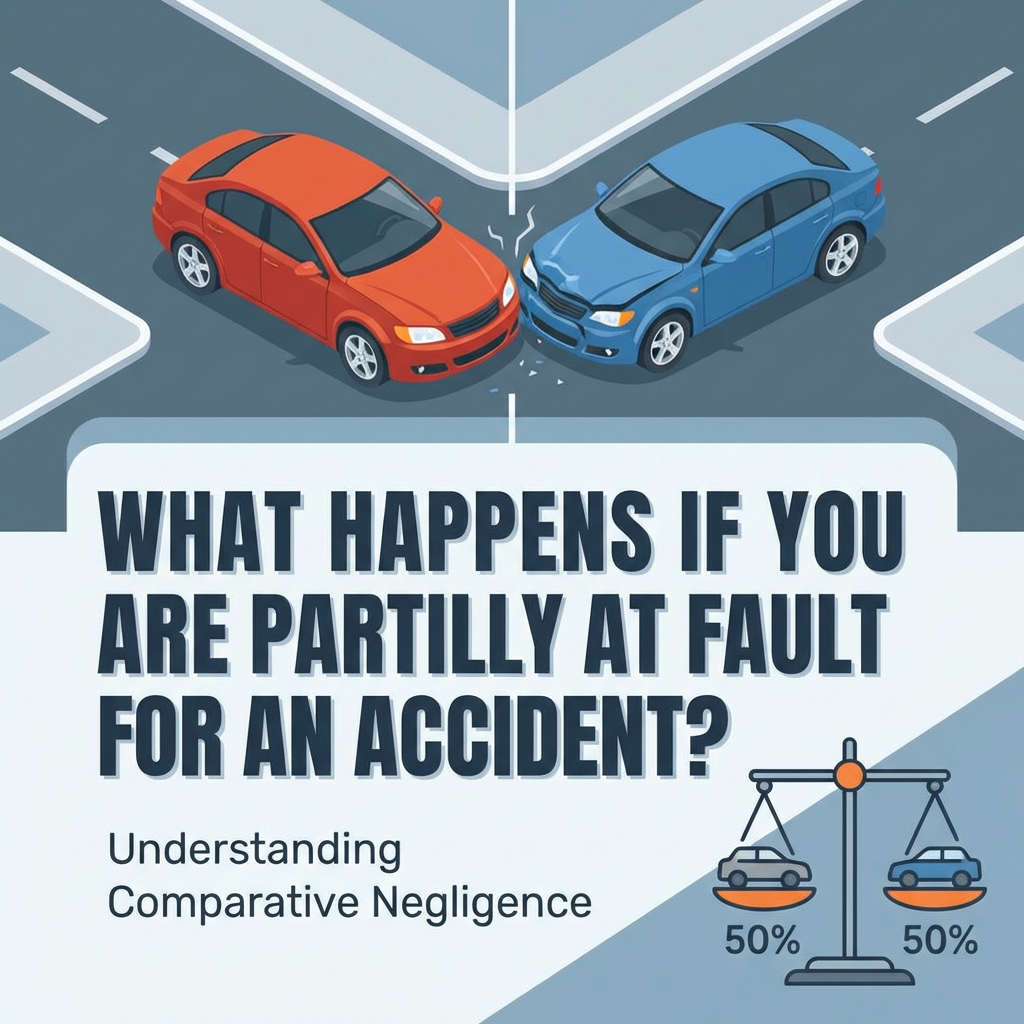
What Happens If You Are Partially at Fault for an Accident?
After an accident, many people immediately ask a difficult question:
“What if the accident was partly my fault?”
It’s a common concern.
Accidents rarely occur in perfectly clear circumstances. Drivers may:
-
misjudge speed
-
change lanes too quickly
-
follow too closely
-
fail to notice another vehicle
-
react too late to avoid impact
Because accidents often involve multiple decisions made in seconds, determining fault is not always simple.
The important thing to understand is this:
Being partially at fault does not automatically prevent you from recovering compensation for injuries.
In many cases, injured people can still pursue an injury claim even if they share some responsibility for the accident.
Understanding how partial fault affects injury claims helps clarify how insurance companies evaluate liability and claim value.
Fault Is Often Shared in Real Accidents
Insurance companies rarely assume one party is 100% responsible immediately.
Instead, adjusters analyze the accident to determine how each driver’s actions may have contributed to the crash.
They may review:
-
police reports
-
driver statements
-
witness statements
-
photographs of the scene
-
vehicle damage
-
traffic laws
-
roadway conditions
-
surveillance or dashcam footage
Based on this information, insurers assign percentages of fault.
For example:
-
Driver A may be considered 70% responsible
-
Driver B may be considered 30% responsible
These percentages influence how compensation is calculated.
Understanding Comparative Fault
Most states use some version of a legal concept called comparative fault (or comparative negligence).
Comparative fault means that responsibility for an accident can be divided between multiple parties.
If an injured person is partly responsible, their compensation may be reduced based on their percentage of fault.
For example:
If a claim is valued at $100,000 and the injured person is found 20% responsible, compensation may be reduced by 20%.
In that scenario:
The injured person could still recover $80,000.
Comparative fault recognizes that accidents often involve shared responsibility.
Modified Comparative Fault vs. Pure Comparative Fault
Different states apply comparative fault rules differently.
Two common systems exist.
Pure Comparative Fault
Under pure comparative fault, an injured person may recover compensation even if they were mostly responsible for the accident.
For example:
-
If someone is 80% responsible, they may still recover 20% of their damages.
This system allows recovery regardless of fault percentage.
Modified Comparative Fault
Many states use modified comparative fault.
Under this system, an injured person may recover compensation only if their fault does not exceed a certain threshold.
Common thresholds include:
-
50% fault rule
-
51% fault rule
If a person is found to be more responsible than the threshold allows, they may not recover compensation.
Because rules vary by state, fault analysis can significantly affect injury claims.
How Insurance Companies Analyze Partial Fault
Insurance companies carefully evaluate liability because fault directly affects claim value.
Adjusters often analyze:
-
traffic law violations
-
right-of-way rules
-
driver reaction time
-
vehicle positioning
-
braking patterns
-
accident reconstruction data
Even small details can influence liability decisions.
For example:
-
Was a turn signal used?
-
Was a driver speeding?
-
Was someone distracted?
-
Did a driver fail to yield?
Each factor may influence the percentage of fault assigned.
Why Insurance Companies May Try to Increase Your Fault Percentage
Insurance companies have financial incentives to minimize claim payouts.
If they can assign a higher percentage of fault to an injured person, the value of the claim decreases.
For example:
A claim valued at $120,000 could become:
-
$96,000 at 20% fault
-
$72,000 at 40% fault
-
$60,000 at 50% fault
Because of this, insurers may closely examine accident details to argue that the injured person contributed to the crash.
This is one reason accident documentation matters.
Evidence That Can Influence Fault Determinations
Several types of evidence often affect how fault is evaluated.
These include:
Police Reports
Police reports often contain:
-
officer observations
-
witness statements
-
citations issued
-
preliminary fault assessments
While not always final, these reports can influence insurance evaluations.
Witness Statements
Independent witnesses can provide valuable perspective.
Their observations may clarify:
-
which driver had the right of way
-
how the collision occurred
-
whether a driver appeared distracted or speeding
Photos and Video
Photographs and video footage can help reconstruct the accident.
Common sources include:
-
intersection cameras
-
nearby security cameras
-
dashcams
-
smartphone recordings
Visual evidence can significantly affect liability determinations.
Vehicle Damage Patterns
Accident reconstruction experts sometimes analyze vehicle damage patterns.
Damage location and severity may reveal:
-
angle of impact
-
direction of travel
-
relative vehicle movement
These details can support or contradict driver statements.
Why Partial Fault Does Not Automatically Ruin a Claim
Many people assume that being partially responsible means they cannot pursue an injury claim.
That assumption is often incorrect.
In many cases, even when fault is shared:
-
medical expenses still exist
-
wage loss still occurs
-
injuries still require treatment
-
pain and suffering still exist
Partial responsibility may reduce compensation.
But it does not necessarily eliminate the claim.
How Partial Fault Affects Settlement Negotiations
When liability is disputed, settlement discussions often focus heavily on fault percentages.
Insurance companies may negotiate by adjusting fault estimates.
For example:
One insurer may argue their driver was only 30% responsible, while the other argues 60% responsibility.
Settlement discussions often involve negotiating these percentages as well as the overall value of the claim.
Because liability affects claim value, fault disputes can significantly influence negotiations.
Why Documentation Still Matters
Even when liability is partially disputed, documentation remains critical.
Insurance companies still evaluate:
-
injury severity
-
medical treatment
-
lost wages
-
long-term impact
As discussed in How Insurance Companies Decide What Your Case Is Worth, liability is only one factor.
Damages still matter.
A well-documented injury can remain significant even when fault is shared.
The Bigger Perspective
Accidents rarely occur in simple, one-sided scenarios.
Drivers make decisions in seconds.
Road conditions change.
Visibility varies.
Traffic patterns shift.
Because of this complexity, many accidents involve some degree of shared responsibility.
The legal system recognizes this reality through comparative fault rules.
The Takeaway
Being partially at fault for an accident does not automatically prevent recovery for injuries.
Insurance companies evaluate:
-
each driver’s actions
-
available evidence
-
applicable traffic laws
-
fault percentages
Compensation may be reduced based on responsibility, but many injured people can still pursue claims even when fault is shared.
Understanding how partial fault works helps clarify how insurers evaluate liability and why documentation remains important in any injury claim.