

What Happens After a Personal Injury Lawsuit Is Filed?
Most personal injury claims resolve through insurance negotiations. However, when settlement discussions do not lead to a fair resolution, filing a lawsuit may become the next step.
For many people, the idea of a lawsuit can feel intimidating simply because the legal process is unfamiliar.
Understanding what happens after a personal injury lawsuit is filed helps clarify how litigation works and why many cases still settle before reaching trial.
The filing of a lawsuit does not necessarily mean the case will go all the way to court. Instead, it begins a structured legal process designed to gather information, evaluate the evidence, and resolve disputes.
Filing the Complaint
The lawsuit process begins when the injured party files a document called a complaint with the court.
The complaint outlines several key elements:
-
the parties involved in the case
-
how the accident occurred
-
the injuries suffered
-
the legal claims being made
-
the compensation being requested
Once the complaint is filed, the defendant must be formally notified of the lawsuit through a process called service of process.
This ensures that the defendant receives official notice that legal action has been initiated.
The Defendant’s Response
After being served with the complaint, the defendant typically has a limited amount of time to respond.
The defendant’s response is usually called an answer.
In this document, the defendant may:
-
admit certain allegations
-
deny other allegations
-
raise legal defenses
-
challenge parts of the complaint
This response establishes the areas where the parties agree and the issues that remain in dispute.
The Discovery Phase
Once the initial pleadings are completed, the case usually enters a stage known as discovery.
Discovery is the process through which both sides gather evidence and information about the case.
This stage is often the longest part of a personal injury lawsuit.
During discovery, attorneys may use several tools to obtain information.
Written Questions (Interrogatories)
One common discovery tool involves written questions known as interrogatories.
These questions may ask about:
-
how the accident occurred
-
the injuries involved
-
medical treatment received
-
prior medical history
-
employment and wage information
The responding party must answer these questions under oath.
Requests for Documents
Attorneys may also request documents related to the case.
These may include:
-
medical records
-
medical bills
-
employment records
-
accident reports
-
insurance policies
-
photographs and videos
Document requests help both sides evaluate the evidence supporting the claims.
Depositions
Depositions are another important part of the discovery process.
During a deposition, a witness answers questions under oath while a court reporter records the testimony.
Depositions allow attorneys to:
-
understand how witnesses describe the accident
-
evaluate credibility
-
clarify medical treatment details
-
identify areas of disagreement
As explained in What Happens During a Personal Injury Deposition?, deposition testimony becomes part of the official case record.
Expert Witnesses
In many injury cases, expert witnesses play an important role.
Experts may provide opinions about:
-
medical diagnoses
-
long-term medical needs
-
accident reconstruction
-
economic losses
-
vocational limitations
Expert testimony helps explain complex issues that may require specialized knowledge.
Insurance companies often evaluate expert opinions when assessing litigation risk.
Motions and Court Hearings
During litigation, attorneys may file motions asking the court to make certain legal decisions.
Examples may include requests to:
-
exclude certain evidence
-
dismiss parts of the case
-
resolve legal disputes before trial
Judges may hold hearings to consider these requests.
These rulings help shape how the case proceeds.
Settlement Discussions During Litigation
Even after a lawsuit is filed, settlement negotiations often continue.
In fact, many cases resolve during the litigation process.
Once both sides have gathered evidence through discovery, the strengths and weaknesses of the case may become clearer.
Insurance companies frequently reassess the claim at this stage.
As discussed in How Insurance Companies Decide What Your Case Is Worth, insurers evaluate litigation risk when determining whether settlement may be appropriate.
Mediation
Many courts encourage or require mediation before a case proceeds to trial.
Mediation is a structured negotiation session in which a neutral third party helps the parties attempt to reach an agreement.
During mediation:
-
both sides present their positions
-
the mediator facilitates discussion
-
settlement options are explored
Mediation does not guarantee a settlement, but it often provides an opportunity to resolve the dispute without trial.
Trial Preparation
If settlement is not reached, the case may proceed toward trial.
Trial preparation can involve:
-
organizing evidence
-
preparing witness testimony
-
reviewing expert opinions
-
developing legal arguments
Attorneys may also prepare exhibits, timelines, and visual materials to present the case clearly to a jury.
Trial preparation ensures that both sides are ready to present their arguments in court.
The Trial
If a case reaches trial, a judge or jury evaluates the evidence presented by both sides.
The trial process may include:
-
opening statements
-
witness testimony
-
expert testimony
-
cross-examination
-
closing arguments
After hearing the evidence, the jury or judge decides whether the defendant is responsible for the injuries and, if so, what compensation should be awarded.
However, it is important to note that many personal injury lawsuits resolve before reaching this stage.
Why Many Cases Settle Before Trial
While filing a lawsuit begins the litigation process, most injury cases still resolve through settlement.
Several factors contribute to this outcome.
As the case progresses, both sides gain a clearer understanding of:
-
the available evidence
-
the credibility of witnesses
-
the strength of medical documentation
-
the potential outcome at trial
This information often helps the parties evaluate the risks of continuing litigation versus reaching a negotiated agreement.
The Bigger Perspective
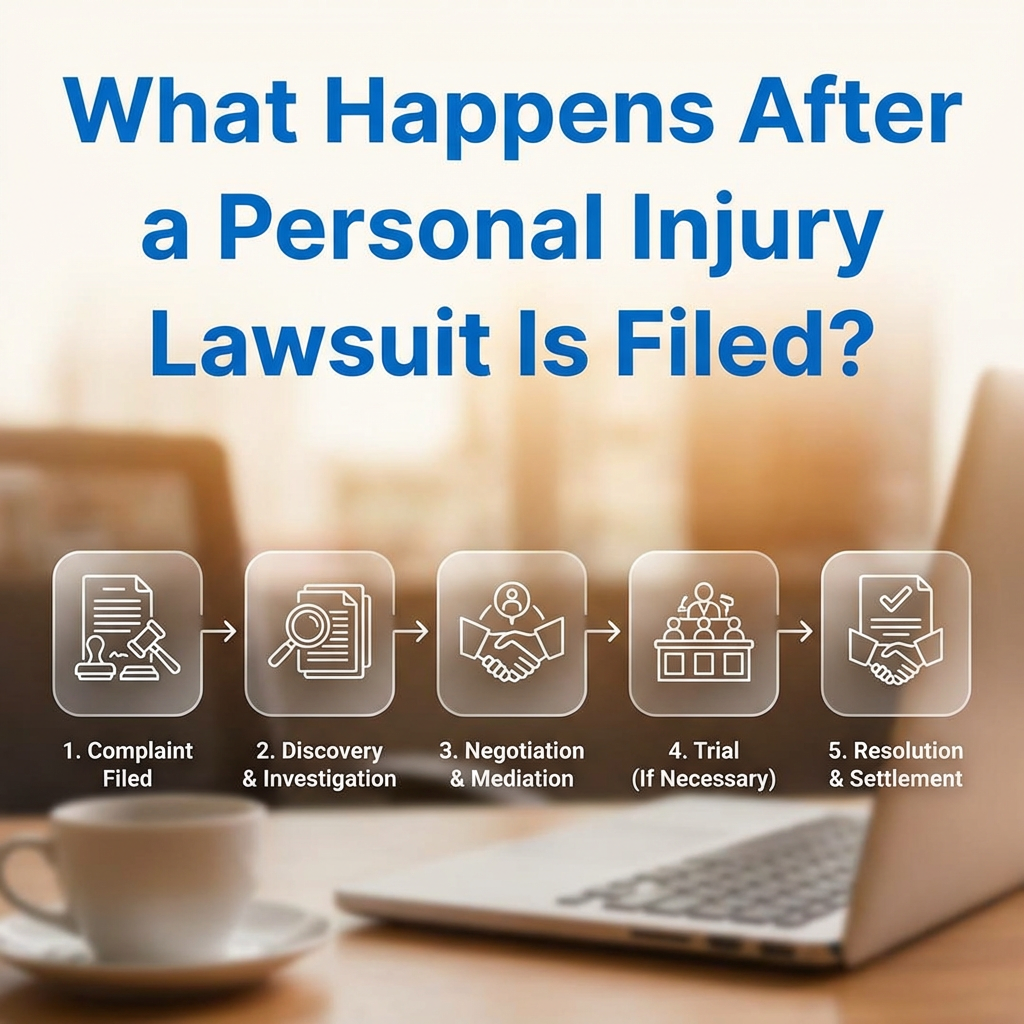
A personal injury lawsuit involves several structured stages designed to gather information and resolve disputes.
These stages typically include:
-
filing the complaint
-
the defendant’s response
-
discovery
-
depositions and expert testimony
-
settlement negotiations or mediation
-
trial preparation and trial if necessary
Each step helps clarify the facts of the case and allows both sides to evaluate the available evidence.
The Takeaway
Filing a personal injury lawsuit begins a formal legal process designed to investigate the accident and evaluate the evidence.
The process may include:
-
written discovery
-
document requests
-
depositions
-
expert testimony
-
settlement negotiations
-
mediation
-
trial preparation
Although litigation can take time, many cases still resolve through settlement after both sides have had the opportunity to review the evidence.
Understanding the stages of a lawsuit helps explain how personal injury cases move forward and why the legal process is structured the way it is.