

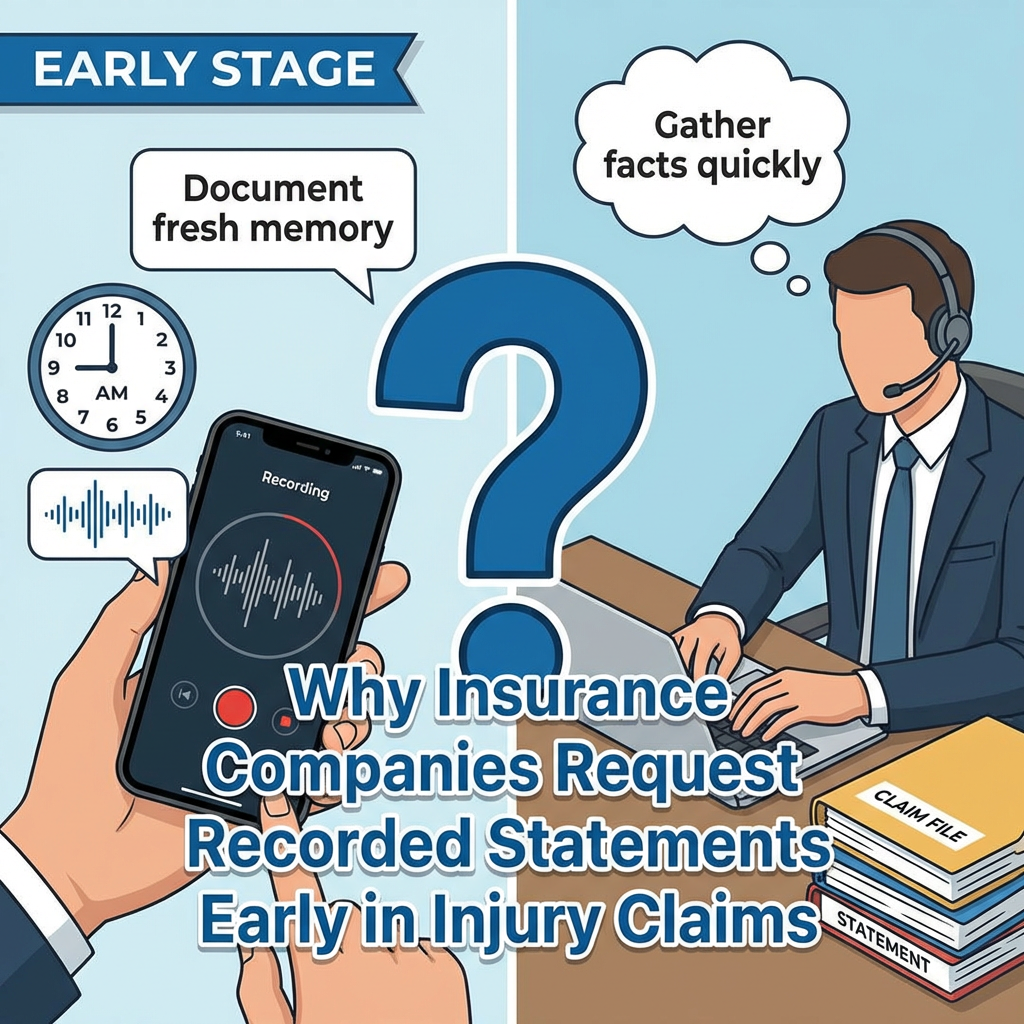
Why Insurance Companies Request Recorded Statements Early in Injury Claims
After an accident, many injured individuals receive a call from an insurance company shortly after the claim is reported.
During this initial contact, the insurance adjuster may ask a series of questions about the accident and may also request a recorded statement.
For many people, this request can feel routine or even harmless. After all, it may seem like the insurance company is simply gathering information about what happened.
However, recorded statements are a standard part of the claims process, and they often play a larger role in how injury claims are evaluated than many people initially realize.
Understanding why insurance companies request recorded statements early—and how those statements may be used later—can help clarify an important part of the injury claim process.
What Is a Recorded Statement?
A recorded statement is a formal account of the accident given by an individual, typically over the phone, while being recorded by the insurance company.
During this conversation, the adjuster may ask questions about:
-
how the accident occurred
-
what the person remembers about the events leading up to the crash
-
whether injuries were noticed immediately
-
what medical treatment has been received so far
The statement is then documented and stored as part of the insurance claim file.
These early statements often become part of how the claim is reviewed over time.
Why Insurance Companies Request Statements Early
Insurance companies often request recorded statements very early in the claims process, sometimes within days of the accident.
There are several reasons for this timing.
1. Capturing Immediate Recollections
Adjusters may want to document how the accident is described shortly after it occurred, while the events are still fresh in memory.
This can include details such as:
-
the sequence of events
-
road conditions
-
traffic signals
-
the actions of each driver
2. Establishing a Baseline Account
The initial statement often serves as a baseline description of the accident.
Insurance companies may later compare this statement with:
-
police reports
-
witness statements
-
physical evidence
-
later communications
3. Beginning the Investigation Process
Recorded statements are often one of the first steps in how insurers begin evaluating a claim.
This process is part of the broader claim investigation, which is discussed in How Insurance Companies Handle Injury Claims.
How Recorded Statements Are Used Later
While recorded statements are taken early, they are not only used at the beginning of a claim.
Insurance companies may revisit these statements later when evaluating key aspects of the case.
Liability Evaluation
Statements may be reviewed when determining who was responsible for the accident.
Adjusters may compare:
-
the recorded statement
-
accident reports
-
witness accounts
to assess whether the descriptions align.
Consistency Analysis
Insurance companies sometimes compare early statements with later statements to determine whether the account of events remains consistent over time.
For example, they may review:
-
how the accident was described initially
-
how it is described later in the claim process
Injury Evaluation
Statements about injuries—especially those made early—may also be reviewed.
For example, insurers may note:
-
whether pain was reported immediately
-
how symptoms were described at the time
-
whether injuries were initially downplayed
This type of review is connected to how insurers analyze medical evidence, which is explained in How Insurance Companies Evaluate Evidence in Injury Claims.
Why Early Statements May Be Incomplete
One important factor to understand is that recorded statements are often given very soon after an accident, when many details may still be unclear.
At this stage, individuals may not yet know:
-
the full extent of their injuries
-
how symptoms will develop over time
-
whether additional treatment will be needed
For example:
-
pain may increase in the days following the accident
-
new symptoms may appear later
-
injuries may worsen with time
This is particularly common in cases involving soft-tissue injuries or head injuries, which are discussed in How Delayed Symptoms Affect Injury Claims.
Because of this, early statements may not reflect the full picture of the situation.
The Role of Stress and Confusion After an Accident
Immediately after an accident, individuals may still be dealing with:
-
shock
-
confusion
-
stress
-
physical discomfort
These factors can affect how clearly events are remembered and described.
For example, someone may:
-
forget certain details
-
describe events differently than they would later
-
be unsure about specific aspects of the accident
Because of this, early statements may not always capture every detail accurately.
Why Recorded Statements Can Become Important in Disputes
As a claim progresses, insurance companies may analyze various types of evidence together.
Recorded statements are often one piece of that overall analysis.
They may be reviewed alongside:
-
medical records
-
accident reports
-
witness statements
-
diagnostic findings
In some cases, insurers may compare early statements with later documentation to evaluate how the claim developed over time.
This is one reason recorded statements are often discussed in Why Recorded Statements Are Dangerous After an Accident, which explains how they can influence claim evaluations.
Statements and Injury Development
Another key factor is that injuries often evolve over time.
For example:
-
neck or back pain may worsen after inflammation develops
-
mobility limitations may become more noticeable later
-
headaches or cognitive symptoms may appear after a delay
Because of this, statements made early in the process may not fully reflect how the injury progresses.
This is particularly relevant in claims involving:
-
whiplash injuries
-
soft-tissue injuries
-
concussions
These types of injuries are discussed further in Why Whiplash Is One of the Most Disputed Injuries and Why Concussions Are Often Missed After Accidents.
Recorded Statements and Claim Evaluation
Insurance companies often evaluate claims by looking at the overall consistency of the available information.
This may include:
-
how the accident was described
-
how injuries were reported
-
how treatment progressed
Recorded statements may be one part of this broader evaluation process.
Because they are taken early, they can sometimes become a reference point for how the claim is analyzed later.
The Takeaway
Insurance companies often request recorded statements early in the claims process as part of their initial investigation.
These statements are used to document how the accident and injuries are described shortly after the event and may later be reviewed alongside other evidence.
Because recorded statements are typically given before the full extent of injuries is known, they may not always reflect how symptoms develop over time.
Understanding how and why these statements are used can help clarify their role in the personal injury claim process.