

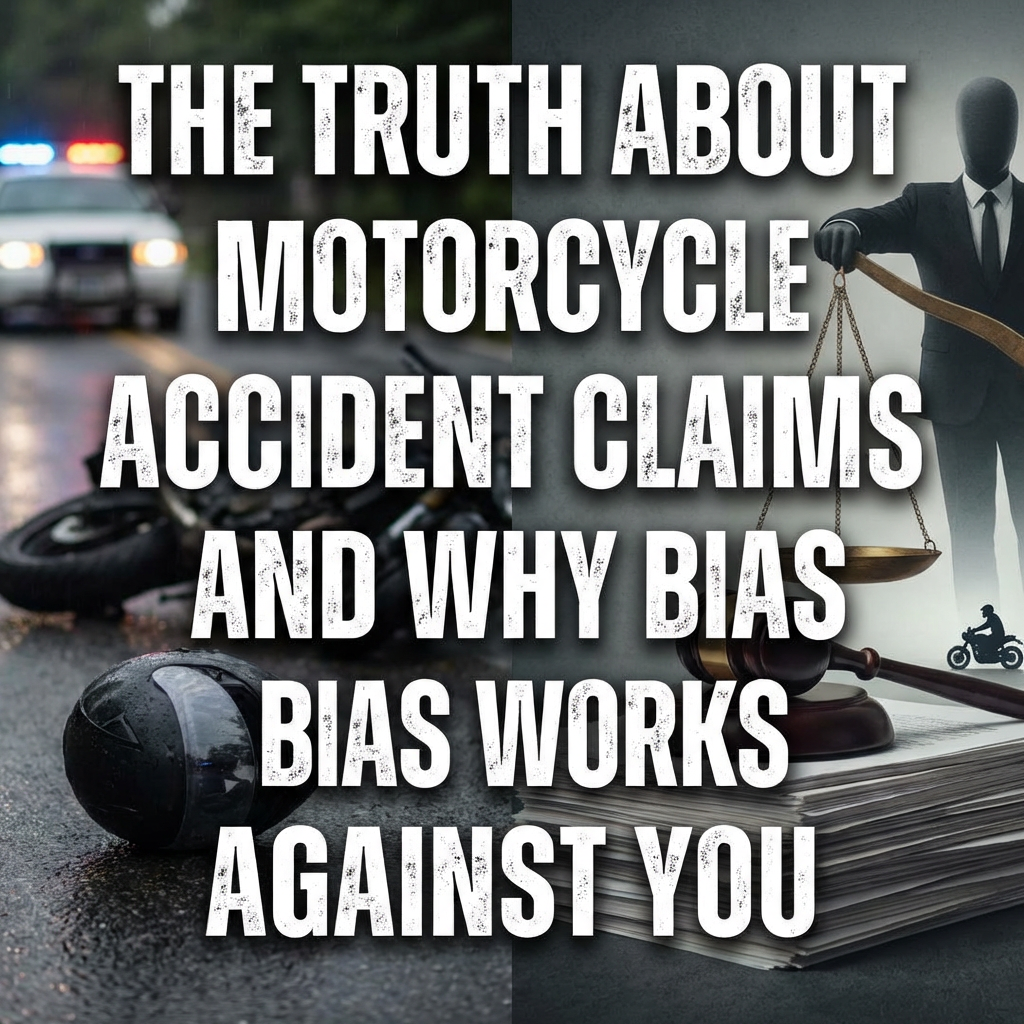
The Truth About Motorcycle Accident Claims and Why Bias Works Against You
If you ride a motorcycle and you’ve been injured in an accident that wasn’t your fault, you are dealing with something that car accident victims don’t face in the same way: a bias problem. It exists in insurance companies. It exists in the people who sit on juries. It exists, if we’re being honest, in the broader culture — a set of assumptions about motorcyclists that follow riders into the claims process and affect outcomes in ways that are rarely acknowledged openly but are very real in practice.
Understanding this bias — where it comes from, how it manifests, and what it actually does to your claim — is not about complaining that the system is unfair. It is about knowing what you are walking into so you can prepare accordingly. The riders who recover full and fair compensation after a serious motorcycle accident are almost always the ones who understood the landscape and had representation that knew how to navigate it.
This article tells you what the insurance company isn’t going to tell you about how bias affects motorcycle claims, and what it means for yours.
Where the bias comes from
The bias against motorcyclists in personal injury claims doesn’t emerge from nowhere. It is built from a set of cultural assumptions that have accumulated over decades — assumptions about who rides motorcycles, why they ride them, and what kind of judgment they exercise on the road.
The dominant cultural narrative around motorcycling in the United States casts riders as risk-takers by nature. People who choose to ride are assumed, at some level, to have chosen danger — to have opted into a more hazardous mode of transportation with full awareness of the consequences. This narrative treats riding itself as evidence of a certain kind of recklessness, and it bleeds directly into how insurance adjusters evaluate claims and how jurors think about cases.
There is also a statistical dimension to this. Motorcycles are genuinely more dangerous than passenger vehicles in the event of a crash. Riders are disproportionately represented in fatal traffic accidents. Insurance companies know these statistics intimately, and those statistics shape their institutional posture toward motorcycle claims. The assumption — often unstated but very much present — is that the rider bears some responsibility for being on a motorcycle at all.
None of this is legally sound. None of it reflects how negligence law actually works. But it is the environment your claim enters the moment you file it, and pretending otherwise doesn’t protect you.
How bias manifests in the insurance claims process
When an insurance adjuster receives a motorcycle accident claim, the evaluation process is shaped by assumptions that don’t apply to car accident claims in the same way. Here is what that looks like in practice.
Speed assumptions. The first thing many adjusters assume about a motorcycle accident is that the rider was going too fast. This assumption often exists independent of any evidence. The adjuster may not have a single piece of documentation suggesting excessive speed, but the presumption is there, and it shapes how they interpret everything else. Witness statements get read through this lens. Accident scene photos get analyzed with speed in mind. The question being answered, from the adjuster’s perspective, is often not “was this rider going too fast” but rather “how do I document that this rider was going too fast.”
Lane positioning and maneuvering. Motorcycles operate differently than cars. Riders lane position intentionally, for visibility and safety. They brake differently. They maneuver through traffic in ways that are legal and reasonable but that look different to someone who only ever drives a car. Insurance adjusters and jurors who don’t ride — which is most of them — often misinterpret normal, safe motorcycle operation as aggressive or reckless behavior.
The helmet issue. If you were not wearing a helmet at the time of your accident, the insurance company will use it. Even in states where helmet use is not legally required for adult riders, the absence of a helmet becomes an argument about your judgment and your contributory responsibility for your own injuries. In states that apply comparative fault principles — which is most of them — the argument is that your failure to wear a helmet contributed to the severity of your head or facial injuries, and that your damages should be reduced accordingly. Whether or not this argument succeeds legally depends on the state and the specific injuries, but you can count on it being made.
The “assumption of risk” argument. This is perhaps the most insidious form of bias in motorcycle accident cases. The insurance company’s position, often never stated directly but always underlying their evaluation, is that by choosing to ride a motorcycle you accepted a higher level of risk — and that this acceptance should reduce what they owe you when someone else’s negligence puts you on the ground. This is not a valid legal doctrine in the way it’s being applied, but it influences settlement offers and litigation strategy in ways that are very real.
How bias manifests in litigation
If a motorcycle accident case proceeds to litigation — either because the insurance company refuses to offer fair value or because the severity of the injuries demands it — the bias problem doesn’t go away. In some ways it intensifies, because now you’re dealing with jurors rather than just adjusters.
Jury selection in motorcycle accident cases is a critical and often underappreciated part of the litigation process. Research on juror attitudes consistently shows that a meaningful percentage of potential jurors carry negative assumptions about motorcyclists before they hear a single fact about the specific case. They assume speed. They assume recklessness. They assume the rider bears some responsibility simply by virtue of having been on a motorcycle.
An experienced motorcycle accident attorney knows this and treats jury selection accordingly — asking questions designed to surface these assumptions, identifying jurors who cannot evaluate the case on its actual facts, and building a panel that will apply the law as it exists rather than the cultural narrative as it persists.
Beyond jury selection, the presentation of a motorcycle accident case requires deliberate attention to how the rider is characterized. The goal is to replace the generic cultural image of the reckless motorcyclist with a specific, accurate picture of who you actually are — a real person, with a family and a life and a reason to be on that road — who was injured because someone else failed to do what the law required of them.
What comparative fault means for your claim
Most states use some form of comparative fault — a legal framework that allows the jury to assign percentages of responsibility to each party involved in an accident. If you are found to be 20 percent at fault for your own injuries, your damages are reduced by 20 percent. In some states, if you are found to be more than 50 percent at fault, you recover nothing at all.
In motorcycle accident cases, comparative fault arguments are the primary vehicle through which bias affects financial outcomes. The insurance company doesn’t need to convince a jury that you were entirely responsible for the accident. They just need to convince them that you were partially responsible — that you were going a little too fast, or that you could have done something to avoid the collision, or that your lane position contributed to the other driver not seeing you. Even a finding of 20 or 30 percent fault on your part significantly reduces your recovery.
This is why documentation matters so much in motorcycle accident cases, and why it needs to begin immediately. Police reports that accurately capture what happened. Witness statements from people who saw the collision. Physical evidence from the scene. Electronic data from the other vehicle if available. Accident reconstruction if the facts warrant it. Every piece of evidence that anchors the story to what actually happened — rather than what the insurance company wants a jury to assume happened — is evidence that fights the comparative fault argument.
The gear question
Your gear at the time of the accident matters in ways that go beyond the helmet issue. Whether you were wearing a jacket, gloves, and appropriate footwear affects not only the severity of your injuries but also how you are perceived by adjusters and jurors evaluating your claim.
A rider in full protective gear — helmet, jacket, gloves, boots — presents a very different picture than a rider in a t-shirt and sandals. The first image is of someone who takes safety seriously, who rides responsibly, who made reasonable choices before getting on the bike. The second image feeds directly into the recklessness narrative that the other side wants to build.
This is not to say that a rider without full gear has no claim, or that gear determines fault. It doesn’t. But in a legal environment where perception matters as much as fact, the gear you were wearing when you crashed is part of the story being told about who you are and how you ride.
What fighting bias actually looks like
The riders who recover fair compensation after serious motorcycle accidents have a few things in common. They documented the accident scene thoroughly. They sought medical treatment immediately and followed through consistently with their care. They worked with an attorney who had specific experience with motorcycle accident cases — not just personal injury cases generally — and who understood how to build a presentation that counters bias rather than ignoring it.
Fighting bias in a motorcycle accident claim means building the strongest possible factual record. It means presenting your case in a way that makes your humanity and your reasonableness impossible to ignore. It means knowing where the insurance company’s arguments are headed before they get there and preparing responses to them. And it means having someone in your corner who has done this before and knows that a motorcycle accident case is a fundamentally different challenge than any other kind of motor vehicle claim.
The law says that if someone else’s negligence caused your injuries, you are entitled to be made whole. That principle doesn’t change because you were on a motorcycle. What changes is how hard you have to work to make sure it’s applied.
If you were injured in a motorcycle accident and you’re concerned about how bias might affect your claim, I want to hear from you. I’m Jelani Aitch, a personal injury attorney. Contact me directly through this website and I’ll personally reach out, hear what happened, and tell you exactly where you stand — no matter where in the United States it happened.