

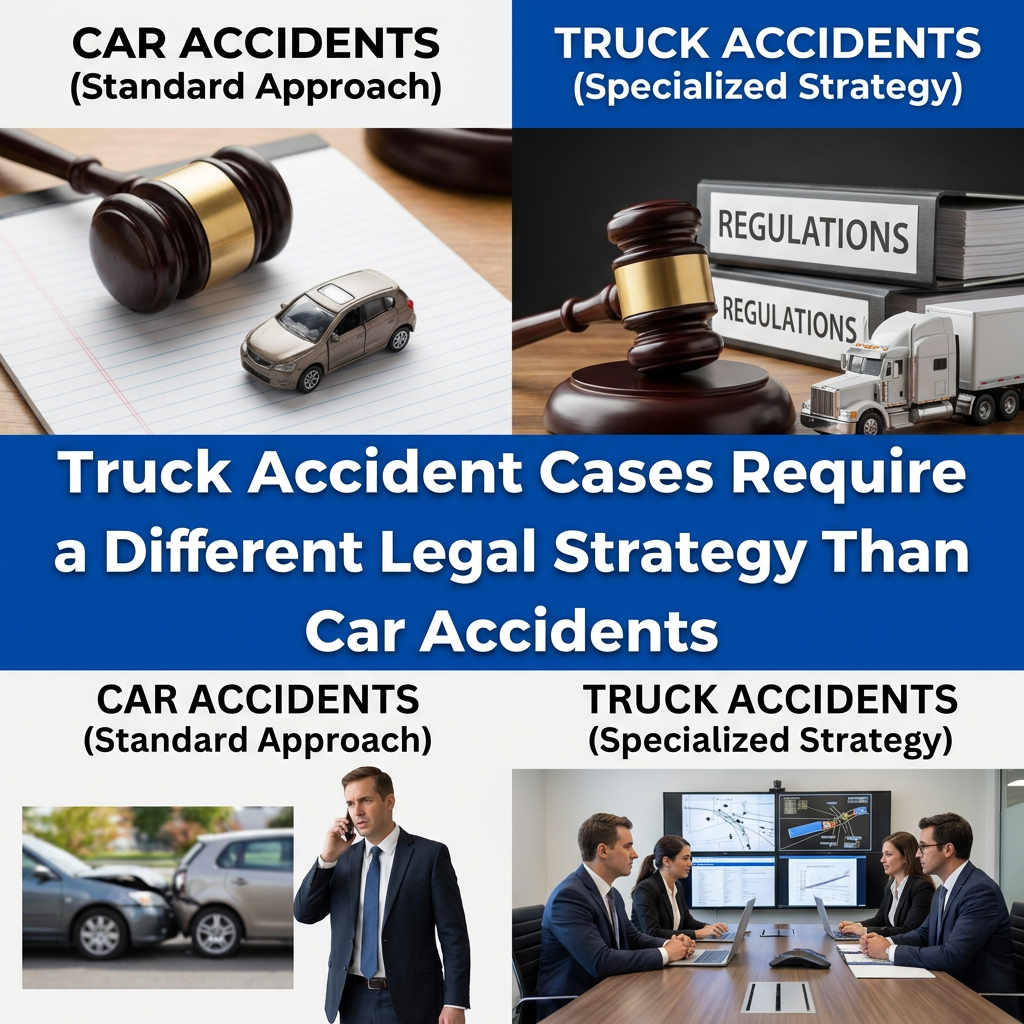
Why Truck Accident Cases Require a Different Legal Strategy Than Car Accidents
When most people think about a truck accident case, they think of it as a car accident case — just bigger. A larger vehicle, more serious injuries, a higher settlement number. The legal process, they assume, is more or less the same.
This assumption is one of the most costly mistakes an injured person can make when they’ve been hurt in a collision with a commercial truck.
A truck accident case is not a scaled-up car accident case. It is a fundamentally different legal matter in almost every meaningful dimension — the defendants, the evidence, the regulatory framework, the insurance structure, the timeline pressures, and the resources arrayed against you. Understanding those differences is not just academically interesting. It is practically essential to protecting your claim and recovering what you are actually owed.
This article explains exactly how truck accident cases differ from car accident cases, why those differences matter, and what they mean for the legal strategy required to handle one successfully.
The defendants are different — and there are more of them
In a car accident case, the legal analysis of who is responsible is usually straightforward. One driver was negligent. That driver has an insurance policy. The claim goes to that insurer. There may be complications — disputes about fault, questions about coverage limits — but the basic structure is simple.
In a truck accident case, the question of who is responsible is almost never that simple, and the answer almost always involves more than one party.
The truck driver individually may bear direct responsibility for what happened — fatigue, distraction, impairment, or a driving error. But the trucking company that employed or contracted with that driver may bear independent responsibility for how they hired, trained, supervised, and dispatched that driver. The company that owns the truck — which may be a separate entity from the company operating it — may bear responsibility for how the vehicle was maintained. If improperly loaded or secured cargo contributed to the crash, the cargo loading company enters the picture. If a defective component — a brake system, a tire, a steering mechanism — played a role, the manufacturer may be liable.
Each of these parties is a potential defendant. Each has their own legal team. Each has their own interest in pointing responsibility at someone else in the chain. Building a truck accident case means identifying all of them, understanding how liability is allocated among them, and constructing a legal strategy that holds each accountable for their specific role in what happened.
This is categorically different from the legal analysis in a standard car accident case, and it requires a different kind of investigation and a different kind of legal expertise.
The evidence is different — and it disappears faster
Car accident cases rely on a relatively familiar set of evidence: the police report, photographs of the scene and vehicle damage, medical records, and witness statements. This evidence is important, and some of it is time-sensitive, but most of it remains available for weeks or months after the crash.
Truck accident cases involve an additional category of evidence that is both uniquely powerful and uniquely perishable.
Commercial trucks are required by federal law to be equipped with electronic logging devices that record hours of service data — how long the driver has been on duty, how long they’ve been driving, and whether they complied with mandatory rest requirements. Many trucks also carry event data recorders that capture speed, braking patterns, throttle position, and other performance data in the seconds before a crash. Some are equipped with forward-facing dash cameras. GPS systems record route data and stopping patterns. The truck itself — its mechanical condition, its tires, its brake system — is physical evidence.
Here is the critical problem: much of this evidence has limited retention windows. Electronic logging device data can be overwritten. Event data recorder information may only be stored for a short period before being overwritten by new data. Dash cam footage gets recycled. The trucking company’s legal team knows this, and they are often on the scene — literally and figuratively — before the injured person has even left the hospital.
A formal legal demand — called a spoliation letter — must be sent to the trucking company as early as possible after a crash, notifying them of their legal obligation to preserve all potentially relevant evidence. Without that demand, evidence can disappear through routine data management processes, and the trucking company faces no legal consequence for its loss.
This is one of the most concrete reasons why getting legal representation immediately after a truck accident is not just advisable but urgent in a way that has no equivalent in car accident cases.
The regulatory framework is different — and violations matter enormously
Car accidents are governed primarily by state traffic laws and general negligence principles. Truck accidents exist within a completely different regulatory environment.
Commercial trucking is one of the most heavily regulated industries in the United States. The Federal Motor Carrier Safety Administration — the FMCSA — has promulgated an extensive set of regulations covering virtually every aspect of commercial trucking operations. Hours of service rules that limit how long a driver can be on duty and behind the wheel before mandatory rest periods. Drug and alcohol testing requirements. Driver qualification standards including licensing, medical certification, and training. Vehicle maintenance and inspection requirements. Cargo securement standards. Rules governing how carriers must respond to accidents.
When a trucking company or its driver violates one of these regulations and that violation contributes to a crash, the violation is not merely a background fact. It is direct evidence of negligence — evidence that the defendant failed to meet a standard of care that a federal regulatory agency determined was necessary to protect the public.
A driver who had been on duty for nineteen hours in violation of hours of service regulations when they fell asleep at the wheel. A truck that passed its last required inspection with brake deficiencies that were not addressed. A carrier that hired a driver with a history of serious traffic violations that federal qualification standards should have excluded. These are not just compelling facts — they are regulatory violations that carry significant legal weight in a negligence case.
Knowing which regulations apply, which were violated, and how to use those violations in building a liability case requires familiarity with the federal regulatory framework that goes well beyond what is relevant in a standard car accident case.
The insurance structure is different — and the stakes are much higher
Federal law requires commercial trucking companies to carry substantially more liability insurance than ordinary passenger vehicles. The minimum coverage for a general freight carrier is $750,000. For carriers transporting certain hazardous materials, the minimum rises to $5 million. Many large carriers carry coverage well in excess of these minimums, and policies may be layered — a primary policy, an umbrella policy, and additional coverage for specific risks.
This means that the potential recovery in a serious truck accident case is dramatically higher than in a typical car accident case. It also means that the resources the other side brings to bear in defending the claim are dramatically higher. When a claim is filed against a major trucking company, the response is not a single adjuster working a file. It is a team — experienced claims professionals, outside defense counsel with specific trucking expertise, accident reconstruction specialists retained by the defense, and medical experts paid to challenge your injury claims.
This is the environment your claim enters. Meeting it effectively requires preparation, expertise, and resources that are simply not necessary in the average car accident case.
The timeline pressures are different — and they begin immediately
In a car accident case, the most time-sensitive steps — documenting the scene, seeking medical treatment, reporting the accident — are important but not usually measured in hours. In a truck accident case, the clock starts running from the moment of the crash in ways that have no equivalent.
The trucking company’s accident response protocols are designed to protect their interests starting immediately. Adjusters are dispatched. Defense counsel is notified. The process of building their defense begins before the injured person has any representation at all.
The evidence preservation issues described above operate on timelines measured in days. Electronic data gets overwritten. The truck gets repaired or returned to service. Witnesses are interviewed by the other side before they’ve been contacted by yours.
This urgency is real and it is specific to truck accident cases in a way that is genuinely different from car accidents. It is not a scare tactic designed to push you into hiring an attorney before you’re ready. It is a practical reality of how these cases work and how evidence in them behaves.
The liability theories are different — and more complex
Car accident cases are almost always built on a single, relatively straightforward negligence theory: the other driver failed to operate their vehicle with reasonable care, and that failure caused your injuries. The legal analysis is familiar and the elements are well understood.
Truck accident cases routinely involve multiple, simultaneous liability theories that require independent legal analysis and independent evidentiary development.
Negligent hiring is the theory that the trucking company hired a driver they knew or should have known was unfit — based on their driving record, their employment history, their medical qualifications, or their drug and alcohol history. Negligent retention is the theory that the company kept a driver they had reason to know was dangerous. Negligent supervision is the theory that the company failed to adequately monitor the driver’s compliance with applicable standards. Negligent entrustment is the theory that the company gave control of the truck to someone they had reason to know should not have been operating it.
Each of these theories has its own elements, its own evidentiary requirements, and its own relationship to the regulatory framework. Building a truck accident case means evaluating all of them against the specific facts of what happened and pursuing each one that the evidence supports.
What this means for you practically
If you were seriously injured in a collision with a commercial truck — or if you lost a family member in one — the practical implications of everything above come down to a few specific things.
Get legal representation immediately. Not eventually. Not after you’ve talked to the insurance company and seen how things develop. Immediately. The timeline pressures are real, the evidence is perishable, and the other side has already begun protecting their interests.
Do not give statements to the trucking company’s insurance carrier. Do not sign anything. Do not accept any offer, regardless of how it is framed or how quickly it is made. Early settlement offers in truck accident cases are almost always made before the full scope of damages is understood, and they are almost always far below what the case is actually worth.
Understand that who handles your case matters enormously. A truck accident case requires specific expertise — in federal trucking regulations, in the evidence that matters and how to preserve it, in the liability theories that apply, and in how to negotiate with and litigate against well-resourced trucking company insurers. Not every personal injury attorney has that expertise. The difference between experienced truck accident representation and general personal injury representation can be measured in the outcome of your case.
If you or someone in your family was seriously injured in a collision with a commercial truck, please don’t navigate this alone. I’m Jelani Aitch, a personal injury attorney. Reach out through this website and I’ll personally learn the details of your situation and help you understand what your case may actually be worth — no matter where in the United States it happened.