

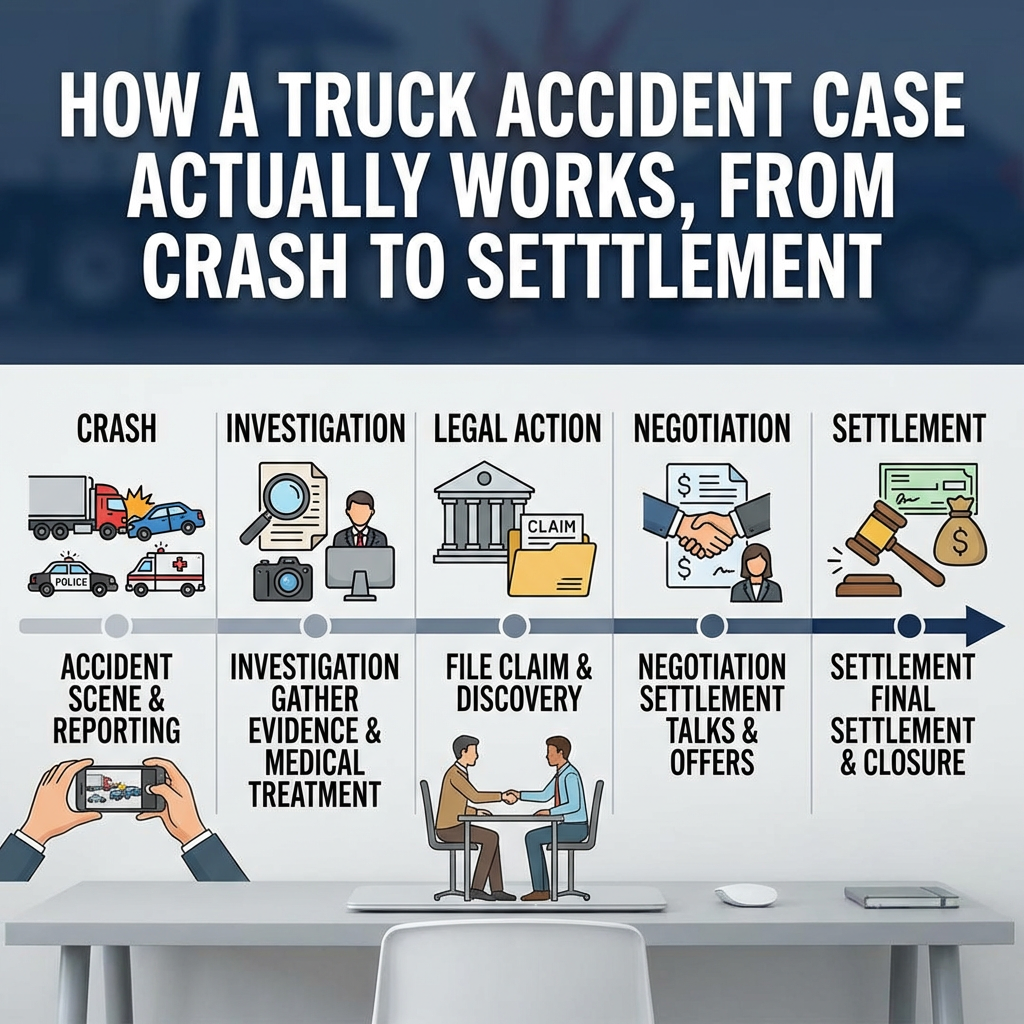
How a Truck Accident Case Actually Works, From Crash to Settlement
If you or someone in your family has been seriously injured in a collision with a commercial truck, you are almost certainly dealing with a level of physical, financial, and emotional disruption that is difficult to overstate. Medical bills are piling up. You may be unable to work. Your vehicle may be totaled. And somewhere in the background, there is an insurance company — probably more than one — that has already begun building its defense.
What most people in this situation don’t have is a clear picture of what actually happens next. The legal process can feel opaque, intimidating, and completely outside of normal experience. People hear terms like demand letter, deposition, and mediation and have no frame of reference for what those things mean or where they fit in the sequence of events.
This article is designed to change that. What follows is a plain-language, stage-by-stage explanation of how a truck accident case actually moves from the day of the crash to the resolution of the claim. Not every case follows this exact path — some settle early, some go to trial, some involve complications that add steps — but this is the general framework, and understanding it gives you the ability to participate meaningfully in your own case rather than simply being carried along by it.
Stage one: The crash and the immediate aftermath
The process begins at the scene, and what happens in those first hours matters more than most people realize.
Commercial trucking companies have legal teams and insurance representatives who are often notified of a serious accident within hours of it happening. In some cases, the trucking company’s accident response team is dispatched to the scene before the injured party has even left the hospital. Their goal in those early hours is to begin gathering evidence and controlling the narrative — not to help you.
What this means practically is that the window for preserving certain types of evidence is extremely short. Commercial trucks are equipped with electronic logging devices that record hours of service data, and many have event data recorders — essentially black boxes — that capture speed, braking, and other performance data in the moments before a crash. Dash cam footage may exist. The truck itself is physical evidence. If a preservation demand is not sent to the trucking company quickly — formally notifying them of their legal obligation to retain this evidence — data can be overwritten, trucks can be repaired, and critical information can disappear.
This is one of the primary reasons why getting legal representation early in a truck accident case is not just advisable but genuinely urgent in a way that doesn’t apply to most car accident cases.
Stage two: The investigation
Once an attorney is involved, the formal investigation begins. This is the stage that lays the foundation for everything that follows, and it typically involves several parallel tracks of work.
The first track is evidence gathering. This includes sending preservation demands to the trucking company, obtaining the police report, gathering all available footage from traffic cameras, dash cams, and nearby businesses, and documenting the accident scene. Skid marks, road conditions, debris fields, and the final resting positions of vehicles all tell a story about how the crash happened and who was responsible.
The second track is a review of the trucking company’s records. Federal regulations require commercial carriers to maintain detailed records on their drivers and vehicles — hiring records, driving history, drug and alcohol testing results, training documentation, vehicle maintenance logs, and inspection records. These records frequently reveal violations that are directly relevant to why the accident happened. A driver who was behind the wheel for more hours than federal law allows. A brake system that hadn’t been properly maintained. A company with a pattern of safety violations. These are not just interesting facts — they are evidence of negligence.
The third track is the medical investigation. Understanding the full scope of your injuries — including future treatment needs, long-term impact on your ability to work, and the full measure of your pain and suffering — requires thorough medical documentation. This often involves working with medical experts who can testify to the nature and permanence of your injuries, the treatment you will require going forward, and what your life looks like as a result of what happened.
Stage three: Identifying all defendants and insurance policies
This is a stage that doesn’t exist in most car accident cases, and it’s one of the things that makes truck accident litigation genuinely different.
In a car accident, you’re typically dealing with one driver and one insurance policy. In a truck accident case, there may be multiple defendants and multiple layers of insurance coverage. The truck driver individually. The trucking company that employed them. The company that owns the truck, if different from the operating carrier. The company responsible for cargo loading, if improperly loaded freight contributed to the crash. The manufacturer of a defective component, if a mechanical failure played a role.
Each of these parties may have their own insurance policy, their own legal team, and their own interest in pointing blame at someone else in the chain. Identifying all of them, understanding how their policies interact, and building a legal strategy that accounts for all of them is a significant part of what a truck accident attorney does in the early stages of a case.
Stage four: The demand package
Once the investigation is substantially complete and the full scope of damages is understood, your attorney prepares a demand package and sends it to the defendants and their insurers.
A demand package is a comprehensive document that lays out the facts of the case, the evidence of liability, the nature and extent of your injuries, and the full calculation of your damages. It includes medical records and bills, documentation of lost wages, expert opinions on future medical needs and lost earning capacity, and a demand for a specific dollar amount to settle the case.
The demand package is not a casual letter. It is a carefully constructed legal document that signals to the other side that you are prepared to go to trial if necessary. The strength of the demand package — the quality of the evidence it contains, the rigor of the damages calculation, the clarity of the liability argument — sets the tone for the negotiation that follows.
After the demand is sent, the insurance company will respond. They may accept, reject, or counter. This begins the formal negotiation phase.
Stage five: Negotiation
Most truck accident cases — like most personal injury cases generally — resolve through negotiation rather than trial. But negotiation in a truck accident case is not a simple back-and-forth. It is a structured process that can involve multiple rounds of offers and counteroffers, and it requires a thorough understanding of what the case is actually worth and what a jury would likely award if it went to trial.
Insurance companies negotiate from a position of experience. They have handled thousands of claims. They know the ranges that cases settle for in different jurisdictions. They know which arguments tend to move juries and which don’t. They have financial incentives to settle for as little as possible.
Your attorney negotiates from a position of preparation — the strength of the evidence, the quality of the medical documentation, the clarity of the liability case, and the credibility of the damages calculation. When both sides have a realistic understanding of what a jury would likely do, there is usually a settlement range that both can agree on.
Mediation is sometimes used at this stage — a structured negotiation session with a neutral third party who helps facilitate an agreement. Mediation is not a trial. It is not binding unless both parties agree to the result. But it is often effective at resolving cases that have stalled in direct negotiation.
Stage six: Filing a lawsuit
If negotiation does not produce a fair settlement, the next step is filing a lawsuit. This is not the end of the road — most cases that are litigated still settle before trial — but it is a significant escalation that changes the dynamic of the case.
Filing a lawsuit triggers the formal discovery process. Both sides are now required to exchange evidence, answer written questions under oath, and sit for depositions — sworn testimony taken before trial. Discovery in a truck accident case can be extensive. The trucking company’s internal communications, safety records, and training materials all become subject to discovery requests. Key witnesses — the driver, company safety officers, dispatch personnel, maintenance staff — may all be deposed.
Discovery often produces evidence that wasn’t available earlier in the process, and that new evidence can significantly affect the settlement value of a case. Cases that seemed like they might go to trial sometimes resolve quickly once discovery reveals how strong the plaintiff’s evidence actually is.
Stage seven: Trial
A small percentage of truck accident cases go all the way to trial. When they do, the process involves jury selection, opening statements, the presentation of evidence through witnesses and exhibits, cross-examination, closing arguments, and jury deliberation.
Truck accident trials can be complex and lengthy. Expert witnesses — accident reconstruction specialists, medical experts, vocational rehabilitation experts, economists — are often called to testify. The trucking company will present its own evidence and witnesses in an effort to minimize liability and damages.
The jury’s verdict determines both whether the defendant is liable and, if so, how much the plaintiff is awarded. In some states, the jury’s finding on comparative fault — whether the plaintiff bears any responsibility for the crash — can affect the final damages award.
It is worth noting that trial is not something to fear. An attorney who is genuinely prepared to try a case — and who has the track record to prove it — negotiates from a fundamentally different position than one who always settles. The credible threat of trial is itself a powerful tool in every negotiation that precedes it.
What this means for you
Understanding the stages of a truck accident case doesn’t make the process easy. But it does make it navigable. You know what is happening and why. You know what your attorney is doing at each stage and what it’s building toward. You know that early action — preserving evidence, getting representation quickly, beginning the investigation before critical data disappears — is not just advisable but genuinely consequential.
Truck accident cases are among the most complex personal injury matters that exist. They involve federal regulations, multiple defendants, sophisticated insurance companies, and injuries that are often catastrophic. The process described above exists because that complexity requires a structured, methodical approach to achieve a just result.
If you or someone in your family was seriously injured in a collision with a commercial truck, please don’t try to navigate this alone. I’m Jelani Aitch, a personal injury attorney. Reach out through this website and I’ll personally learn the details of your situation and help you understand what your case may actually be worth — no matter where in the United States it happened.