

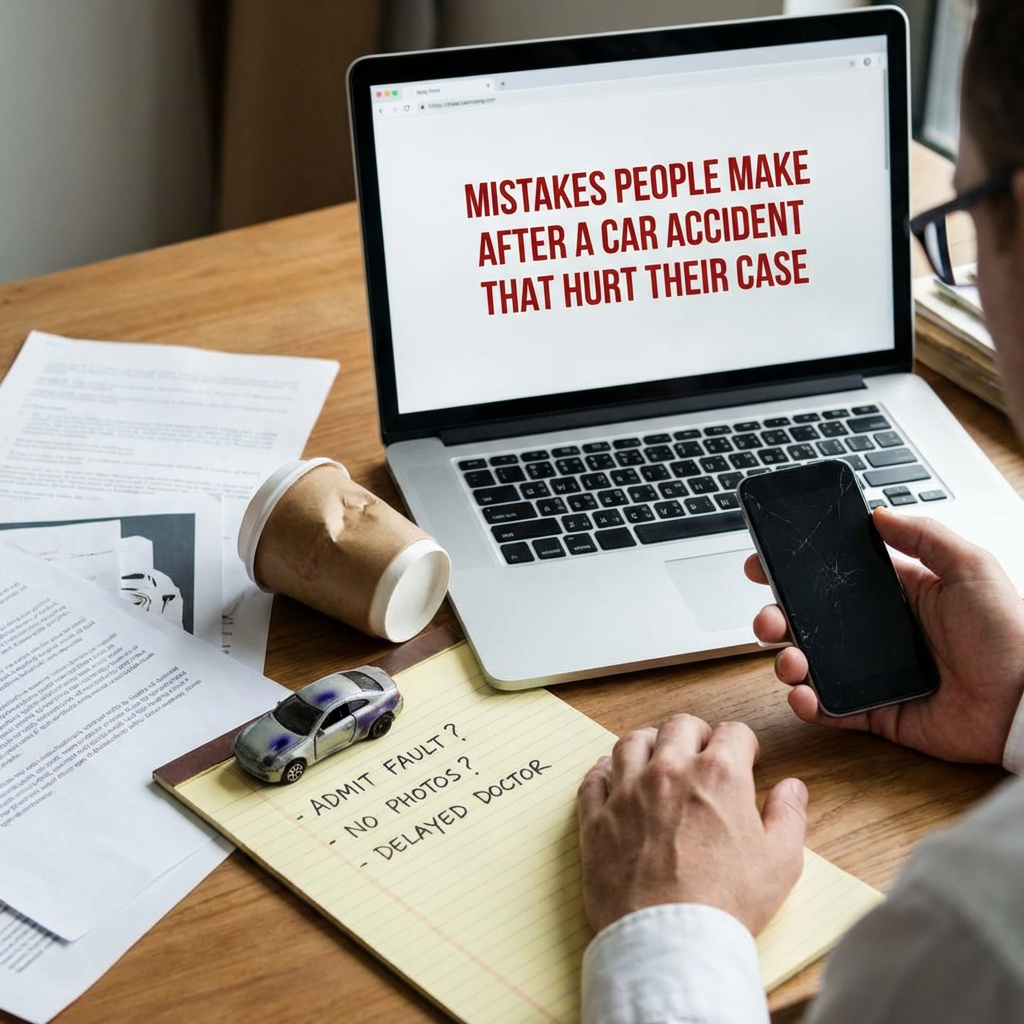
Mistakes People Make After a Car Accident That Hurt Their Case
The decisions that most affect the outcome of a car accident claim are almost never made in a courtroom or a lawyer’s office. They are made in the minutes and hours immediately after a crash — when you’re shaken, possibly in pain, possibly in shock, and operating entirely on instinct without any framework for what actually matters legally.
Most people have never been through a serious car accident before. They don’t know what to do. They do what feels natural — they apologize, they tell the other driver they feel fine, they accept the first offer that comes their way because they want the whole thing to be over. These instincts are human and understandable. They are also, from a legal standpoint, frequently devastating.
This article is about the specific mistakes that most commonly damage car accident claims, why each one causes the harm it does, and what to do instead. If you have already made some of these mistakes, keep reading — some of the damage is recoverable, and understanding where you stand is the first step.
Mistake one: Apologizing at the scene
This one is almost universal. A collision happens. Both drivers get out of their vehicles. The first thing many people say — reflexively, automatically, out of basic social conditioning — is some version of “I’m so sorry.”
Those two words, spoken at the scene of an accident before anyone knows the full facts, can cause serious problems for your claim. Here is why.
In the legal context of a personal injury claim, an apology is an admission. The other driver, their insurance company, and potentially their attorney will treat “I’m sorry” as an acknowledgment of fault. It doesn’t matter that you meant it as a social reflex rather than a legal statement. It doesn’t matter that you didn’t know yet who was at fault. It goes in the incident report. It gets repeated to the adjuster. It becomes part of the record.
This doesn’t mean you should be cold or confrontational at the scene of an accident. You can be kind, calm, and cooperative without making statements about fault or responsibility. Ask if the other person is okay. Call for help if needed. Exchange insurance and contact information. What you should avoid is any statement — apology, explanation, or speculation — about who caused the crash or who is responsible for what happened.
Mistake two: Declining medical attention at the scene
When emergency responders arrive at an accident scene and ask if you need medical attention, many people say no. They feel okay. They’re embarrassed. They don’t want the drama of an ambulance. They want to get home.
The problem is that “feeling okay” immediately after a car accident is not a reliable indicator of whether you are okay. Adrenaline is a powerful physiological response to sudden stress and physical trauma. It suppresses pain signals. It creates a sense of alertness and normalcy that can mask injuries that are very real and very serious. Whiplash, concussions, soft tissue injuries, and spinal injuries — some of the most common consequences of motor vehicle accidents — often don’t produce their full symptom load until hours or days after the crash.
When you decline medical attention at the scene and then seek treatment two or three days later, you have created a gap in the timeline that the insurance company will use against you. Their argument is straightforward: if you were really injured, you would have accepted treatment when it was offered. The gap becomes evidence that either the injury isn’t serious or that it wasn’t caused by the accident.
If emergency responders offer medical attention at the scene, accept it. If you leave the scene without treatment, go to an urgent care or emergency room the same day. The connection between the accident and your injuries is strongest when the timeline is tight, and that connection is one of the most important elements of your claim.
Mistake three: Not calling the police
Minor accidents — fender benders, low-speed collisions, crashes where nobody appears to be seriously hurt — often tempt people to handle things informally. Both drivers agree to exchange information without involving law enforcement, avoid the hassle of a police report, and deal with each other’s insurance companies directly.
This almost always works out worse for the person who was not at fault.
A police report is an official, contemporaneous record of what happened. It documents the date, time, location, vehicles involved, driver information, and the responding officer’s observations about the scene and the circumstances of the crash. It may include the officer’s assessment of fault or citations issued. It is an independent, third-party document that exists regardless of what either driver says later.
Without a police report, your account of what happened has nothing to anchor it. The other driver can tell their insurance company a completely different version of events. The details you both agreed on at the scene can be contradicted or forgotten. The accident that seemed simple and clear-cut becomes a he-said-she-said dispute with no official record to resolve it.
Call the police even for accidents that seem minor. Wait for them to arrive. Give your account of what happened clearly and factually. And get the report number before you leave so you can obtain a copy.
Mistake four: Not documenting the scene
Even when people know they should document the accident scene, they often don’t do it thoroughly enough — or they do it after the scene has already changed.
The scene of a car accident contains evidence that exists in that form for only a brief window. Skid marks fade. Vehicle positions change once cars are moved to the shoulder. Debris gets cleared. Weather conditions that contributed to the crash don’t last. Traffic patterns at the time of the accident won’t be recreated.
Before vehicles are moved — if it is safe to do so — photograph everything. The final positions of all vehicles involved. Damage to every vehicle from multiple angles. Skid marks and road surface conditions. Traffic signals, signs, and road markings relevant to the intersection or stretch of road where the crash happened. The surrounding environment that gives context to where the accident occurred. Any visible injuries on yourself or others involved.
Also photograph the other driver’s license, registration, and insurance card. Get the names and contact information of any witnesses. If there are nearby businesses with exterior security cameras that might have captured the crash, note their locations — your attorney can later request that footage before it’s overwritten.
The documentation you do in those first minutes is irreplaceable. Nothing that comes later can fully substitute for it.
Mistake five: Giving a recorded statement to the other driver’s insurance company
Within days of an accident — sometimes within hours — you will likely receive a call from the other driver’s insurance company. The adjuster will introduce themselves, express concern for your wellbeing, and ask if they can record a statement from you about what happened.
This request is not a formality. It is not a requirement. And agreeing to it before you have legal representation is one of the most common and most costly mistakes car accident victims make.
Recorded statements taken in the immediate aftermath of an accident capture you at your most vulnerable — before you know the full extent of your injuries, before you’ve had legal advice, and before you understand the implications of what you’re saying. The questions are designed by experienced claims professionals to produce answers that limit the company’s liability. “How fast were you going?” “Did you see the other vehicle before impact?” “On a scale of one to ten, how would you rate your pain right now?” These questions seem straightforward. Their answers become tools.
You are not legally required to give a recorded statement to the other driver’s insurance company. You have the right to decline and to tell them that you will be in touch through your attorney. Exercise that right. If you don’t yet have an attorney, decline the recorded statement and get one before you engage further with the other side’s insurer.
Mistake six: Accepting the first settlement offer
The speed with which insurance companies offer settlements after car accidents is not accidental. The first offer almost always comes before the injured person has a complete picture of their damages — before all medical treatment is done, before future needs are fully understood, before lost wages have been fully calculated. It comes at the moment of maximum uncertainty and maximum desire to just have this be over.
And that is precisely the point.
A settlement offer, once accepted and a release signed, is final. It cannot be revisited. It cannot be increased when you discover your injury requires surgery. It cannot be supplemented when you find out you’ll need six more months of physical therapy. The insurance company’s obligation to you ends the moment you accept.
Before you accept any settlement offer, you need to know the full scope of your damages. That means understanding what your medical treatment will actually cost, including future treatment. It means calculating your lost wages — both past and projected. It means understanding what pain and suffering compensation looks like for injuries like yours. It means having a realistic picture of what your case is actually worth, from someone who knows what cases like yours settle for.
That picture almost never comes from the insurance company. It comes from an attorney who is on your side.
Mistake seven: Posting about the accident on social media
In the days and weeks after a car accident, many people post about the experience on social media. Sometimes it’s to update friends and family. Sometimes it’s to vent about what happened. Sometimes it’s an innocent photo from a weekend event that has nothing to do with the accident at all.
Insurance companies and defense attorneys monitor the social media of claimants as a routine part of claims evaluation. A post that says you’re “feeling better” becomes evidence that your injuries aren’t serious. A photo of you standing at a family gathering becomes an exhibit in an argument that you’re more mobile and less impaired than you claim. A check-in at a restaurant or an event becomes a data point about your activity level.
None of this is fair, and none of it tells the full story of what you’re actually going through. But fairness is not the standard by which social media evidence gets used. Usefulness to the defense is.
The safest course is to stay off social media entirely while your claim is active. If that’s not realistic, be extremely thoughtful about what you post and what others post about you. Assume that anything publicly visible will be seen by the other side. Because it will.
Mistake eight: Waiting too long to consult an attorney
There is a pervasive belief that hiring an attorney is something you do when things get complicated — when the insurance company denies your claim, when negotiations break down, when you’re already deep in a dispute. Most people think of an attorney as a last resort rather than a first call.
This belief costs people money, and sometimes it costs them their case entirely.
Evidence disappears quickly after a car accident. Witness memories fade. Traffic camera footage gets overwritten. Electronic data from vehicles has retention limits. The sooner an attorney is involved, the sooner preservation demands can be sent and the sooner the investigation can begin while the evidence is still available.
Beyond evidence preservation, an attorney’s involvement from the beginning changes the entire dynamic of the claims process. You stop being an unrepresented individual navigating a system designed by people with more experience than you. You become someone with an advocate who knows the system, who knows what your case is worth, and who the insurance company knows will not accept less.
Most personal injury attorneys work on a contingency fee basis — they don’t get paid unless you do, and their fee comes out of the settlement rather than out of your pocket. There is no financial barrier to making that first call, and making it early is almost always to your advantage.
If you’ve already made some of these mistakes
Some of the mistakes above can be partially remedied. A gap in medical treatment can be addressed by resuming consistent care and working with your doctor to document the continuity of your injuries. A premature recorded statement can be contextualized and addressed by an experienced attorney. Social media posts can sometimes be managed depending on what was said and when.
What cannot be remedied is a signed release. If you have already accepted a settlement and signed a release, your claim is almost certainly closed. This is why the time before you sign anything is the most important window — and why understanding these mistakes before you make them is so much more valuable than understanding them after.
If you were in a car accident and you’re concerned about where your claim stands — whether you’ve made some of these mistakes or you’re trying to make sure you don’t — I want to hear from you. I’m Jelani Aitch, a personal injury attorney. Contact me directly through this website and I’ll personally reach out, hear what happened, and tell you exactly where you stand — no matter where in the United States it happened.