

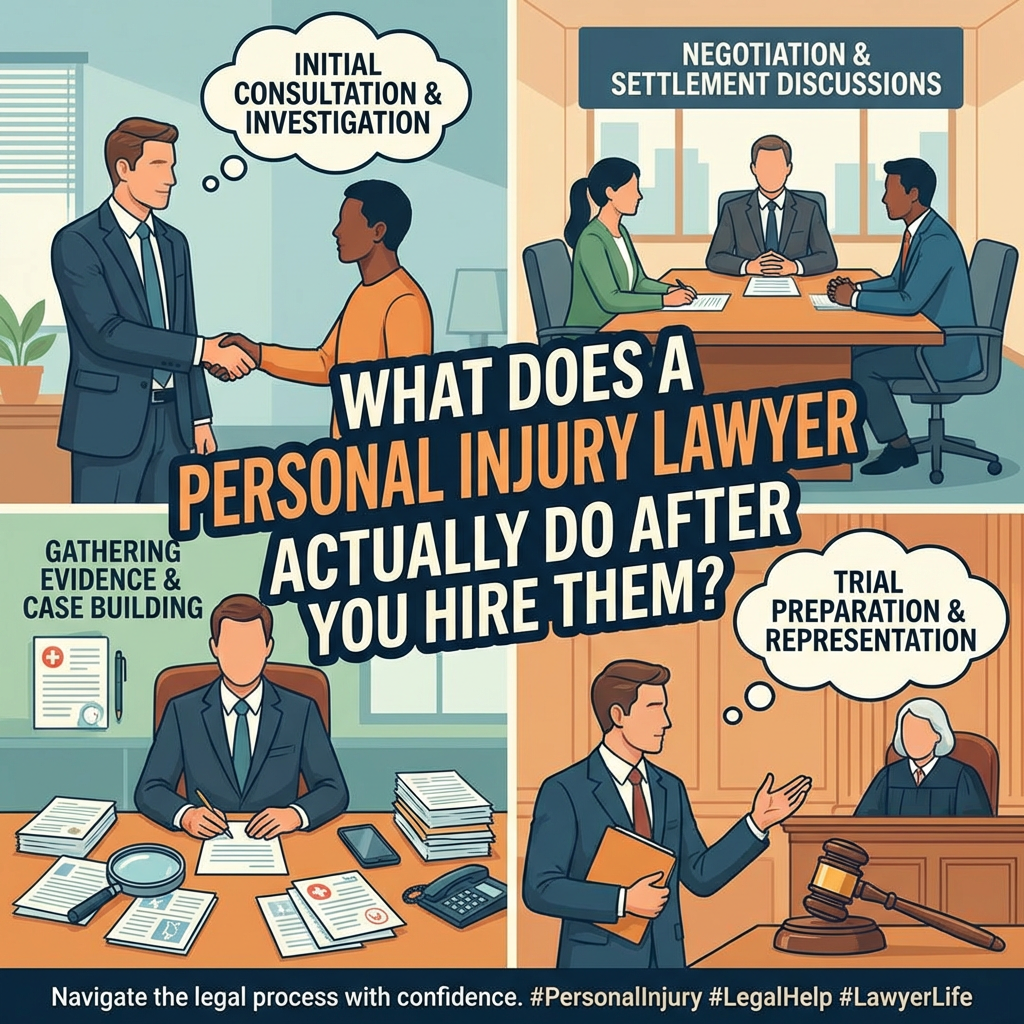
What Does a Personal Injury Lawyer Actually Do After You Hire Them?
Many people hesitate to hire a personal injury lawyer because they’re unsure what happens next.
They assume:
-
A lawsuit gets filed immediately.
-
The process becomes aggressive.
-
Everything escalates.
-
Communication becomes complicated.
In reality, most injury claims follow a structured process.
Hiring a lawyer does not automatically mean filing a lawsuit.
It usually means something much simpler:
The claim becomes organized strategically.
Understanding what a personal injury lawyer actually does after being hired helps remove uncertainty and clarify expectations.
Step One: Structural Reset
When a lawyer enters a case, the first thing that typically happens is a structural reset.
This includes:
-
Notifying the insurance company of representation.
-
Requesting claim documentation.
-
Confirming policy information.
-
Reviewing liability details.
-
Gathering initial medical records.
From the insurer’s perspective, the claim shifts from informal handling to structured handling.
That shift alone can change internal evaluation posture.
As discussed in When Is the Right Time to Hire a Personal Injury Lawyer?, timing affects leverage.
Representation formalizes leverage.
Step Two: Documentation Review
Most injury claims are won or weakened based on documentation.
After being hired, a lawyer typically:
-
Collects all medical records.
-
Reviews treatment consistency.
-
Identifies documentation gaps.
-
Evaluates causation clarity.
-
Assesses injury severity.
-
Analyzes billing structure.
In many cases I’ve reviewed, early documentation weaknesses are repairable — but only if identified quickly.
The goal is not escalation.
The goal is structure.
Step Three: Protecting the Client From Common Mistakes
One of the most overlooked functions of legal representation is prevention.
A lawyer often prevents:
-
Harmful recorded statements.
-
Premature settlement discussions.
-
Unnecessary medical authorizations.
-
Social media missteps.
-
Casual communication errors.
-
Timeline mistakes.
Insurance companies begin evaluating claims immediately.
Without guidance, small early mistakes can compound.
Representation reduces that risk.
Step Four: Monitoring Medical Progress
A personal injury lawyer does not direct medical treatment.
But they do monitor how treatment affects:
-
Documentation clarity.
-
Causation narrative.
-
Functional impact.
-
Prognosis development.
The timing of settlement discussions often depends on:
-
Maximum medical improvement (MMI).
-
Stabilization of symptoms.
-
Clear future treatment outlook.
Settling too early can undervalue a claim.
Waiting too long without strategy can stall progress.
Monitoring ensures timing aligns with leverage.
Step Five: Evaluating Claim Value Strategically
Claim value is not determined by adding medical bills.
It is evaluated through:
-
Injury severity.
-
Treatment duration.
-
Functional limitation.
-
Future medical risk.
-
Wage impact.
-
Credibility.
-
Litigation risk.
As explained in How Insurance Companies Decide What Your Case Is Worth, valuation is risk-based.
A lawyer’s role is to assess the same risk factors insurers use — but from the claimant’s side.
That includes identifying:
-
Strengths in documentation.
-
Weaknesses in causation.
-
Areas requiring clarification.
-
Exposure growth over time.
Step Six: Negotiation Strategy
Negotiation is rarely a single demand and counteroffer.
It involves:
-
Strategic timing.
-
Documentation presentation.
-
Narrative clarity.
-
Risk signaling.
-
Reserve pressure.
-
Litigation evaluation.
In my experience observing how negotiations unfold, structured negotiation often produces better outcomes than reactive negotiation.
Reactive negotiation responds to insurer offers.
Structured negotiation frames exposure intentionally.
Step Seven: Litigation Evaluation (If Necessary)
Most claims resolve without trial.
But credible litigation possibility influences negotiation.
If settlement discussions stall, a lawyer evaluates:
-
Liability clarity.
-
Venue considerations.
-
Jury risk.
-
Expert needs.
-
Cost-benefit analysis.
-
Timeline impact.
Filing a lawsuit is a strategic decision — not an emotional one.
Insurance companies respond differently when litigation risk increases.
That response is structural.
What a Lawyer Does Not Do
It’s equally important to clarify what typically does not happen.
Hiring a lawyer does not automatically mean:
-
Immediate court filing.
-
Aggressive confrontation.
-
Public escalation.
-
Unnecessary conflict.
Most cases remain negotiation-focused.
Representation changes posture, not tone.
The Experience Pattern
Over time, one consistent pattern emerges:
Claims with structured handling tend to maintain leverage better than claims handled reactively.
That does not mean every represented case resolves higher.
But it does mean:
-
Documentation is reviewed strategically.
-
Timing decisions are intentional.
-
Mistakes are reduced.
-
Exposure signals are clearer.
Structure protects value.
Why Timing Still Matters
Even after hiring a lawyer, timing remains critical.
Settlement discussions often occur after:
-
Medical stabilization.
-
Clear prognosis.
-
Complete documentation.
-
Future care evaluation.
Settling before understanding the full medical picture can permanently limit recovery.
Waiting without strategy can prolong resolution unnecessarily.
The balance lies in informed timing.
The Bigger Perspective
Hiring a personal injury lawyer does not transform a claim into conflict.
It transforms a claim into structure.
Insurance companies evaluate claims through risk frameworks.
Legal representation engages that same framework intentionally.
If you want to understand how insurers approach claims internally, visit:
Because representation primarily influences risk evaluation — not emotion.
The Takeaway
After you hire a personal injury lawyer, they typically:
-
Reset claim structure.
-
Protect you from early mistakes.
-
Review documentation strategically.
-
Monitor medical progress.
-
Evaluate claim value using risk factors.
-
Negotiate intentionally.
-
Assess litigation only when necessary.
Representation is not escalation.
It is organization.
And in injury claims, organization often determines leverage.