

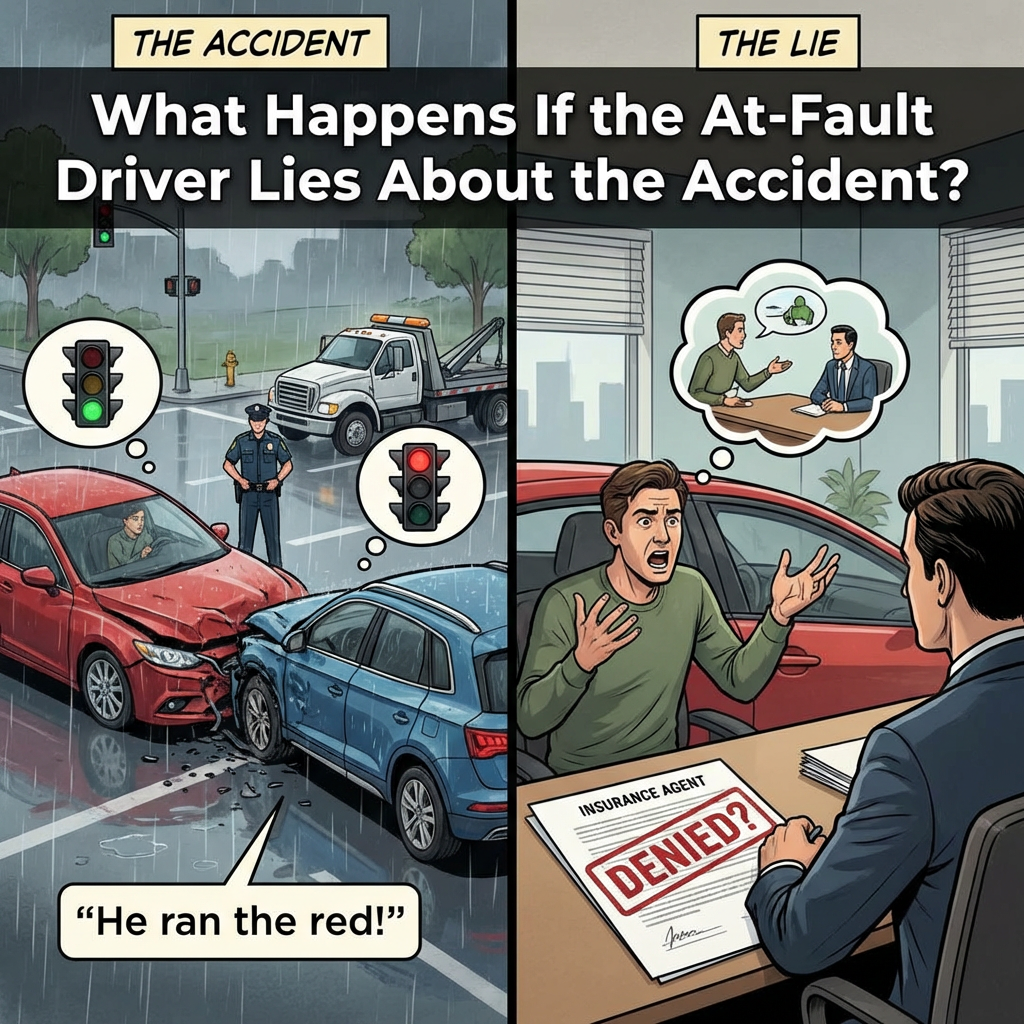
What Happens If the At-Fault Driver Lies About the Accident?
After a car accident, one of the most frustrating situations an injured person can face is discovering that the other driver is telling a different version of what happened.
Sometimes drivers deny responsibility entirely. In other cases, they may change details about how the accident occurred or shift blame to the other party.
When this happens, accident victims often worry that the false statements will prevent them from recovering compensation.
In reality, insurance companies and investigators rely on multiple sources of evidence when evaluating accident claims. A driver’s statement is only one piece of the overall investigation.
Understanding how insurance companies evaluate conflicting accounts can help clarify what typically happens when accident stories do not match.
Why Drivers Sometimes Dispute Fault
After a crash, drivers may have different recollections of the event. However, there are also situations where one driver intentionally denies responsibility.
Several factors can influence this behavior, including:
-
concern about insurance premiums increasing
-
fear of being held financially responsible
-
misunderstanding of traffic laws
-
confusion about how the accident occurred
Regardless of the reason, conflicting accounts are not unusual in accident claims.
Insurance companies are accustomed to investigating accidents where both parties describe the event differently.
How Insurance Companies Investigate Accidents
When accident accounts conflict, insurance companies usually conduct an investigation to determine what most likely occurred.
This investigation often includes reviewing several types of evidence, such as:
-
police reports
-
photographs from the accident scene
-
vehicle damage patterns
-
witness statements
-
traffic camera footage
Each of these sources helps the insurance company build a clearer picture of the accident.
Even when drivers disagree about what happened, physical evidence and third-party reports often provide valuable insight.
The Importance of the Police Report
Police reports often play an important role when accident details are disputed.
Officers who respond to the scene typically document:
-
the location of the vehicles
-
road conditions
-
visible damage
-
statements from drivers and witnesses
The report may also contain the officer’s observations about what likely caused the accident.
Although police reports are not always the final determination of liability, they can provide useful context for insurance investigators.
Witness Statements
Independent witnesses can be especially helpful when drivers provide conflicting versions of the accident.
Witnesses may describe:
-
the direction vehicles were traveling
-
which driver had the right of way
-
whether traffic signals were involved
-
the sequence of events leading up to the collision
Because witnesses are not directly involved in the accident, their statements may carry significant weight during the investigation.
Physical Evidence From the Scene
Physical evidence can also provide important clues about how an accident occurred.
Examples include:
-
skid marks on the road
-
the position of vehicles after the crash
-
debris patterns
-
damage to the vehicles
Accident investigators sometimes analyze this information to determine how the vehicles collided.
In many cases, the physical evidence aligns more closely with one driver’s version of events than the other.
The Role of Photographs and Video
Photographs taken at the scene can be extremely valuable when fault is disputed.
Images may capture:
-
vehicle positions
-
traffic signals or signs
-
road conditions
-
damage to both vehicles
Video footage from nearby traffic cameras, businesses, or dash cameras can also provide important evidence.
When available, video evidence often offers the clearest view of how an accident occurred.
How Insurance Companies Determine Liability
Insurance companies evaluate liability by reviewing all available evidence rather than relying solely on a driver’s statement.
Investigators typically compare:
-
the statements provided by both drivers
-
the police report
-
witness accounts
-
physical evidence from the scene
-
vehicle damage patterns
By analyzing these sources together, insurers attempt to determine which version of events is most consistent with the evidence.
As discussed in How Insurance Companies Evaluate Evidence in Injury Claims, insurers rely heavily on documentation when making liability decisions.
What Happens When Fault Is Still Disputed
Sometimes the available evidence does not clearly establish who caused the accident.
In those situations, insurers may determine that responsibility is shared between the drivers.
This is known as comparative fault, where each party may bear some portion of responsibility for the accident.
As explained in What Happens If You Are Partially at Fault for an Accident, shared fault can influence how insurance claims are evaluated.
Why Evidence Matters in Accident Claims
When accident details are disputed, documentation often becomes extremely important.
Evidence collected early in the process can help clarify what happened and reduce uncertainty during the investigation.
Examples of useful documentation include:
-
photos taken at the scene
-
contact information for witnesses
-
copies of the police report
-
medical documentation of injuries
These materials help insurance companies evaluate the claim more accurately.
The Takeaway
When the at-fault driver disputes what happened during an accident, insurance companies usually conduct a broader investigation rather than relying solely on the driver’s statement.
Evidence such as police reports, witness accounts, photographs, and physical damage patterns often play a key role in determining what most likely occurred.
Even when drivers provide conflicting versions of events, the available documentation and evidence typically help investigators reach a conclusion about liability.
Understanding how insurance companies investigate disputed accidents can help clarify how claims are evaluated when fault is contested.