

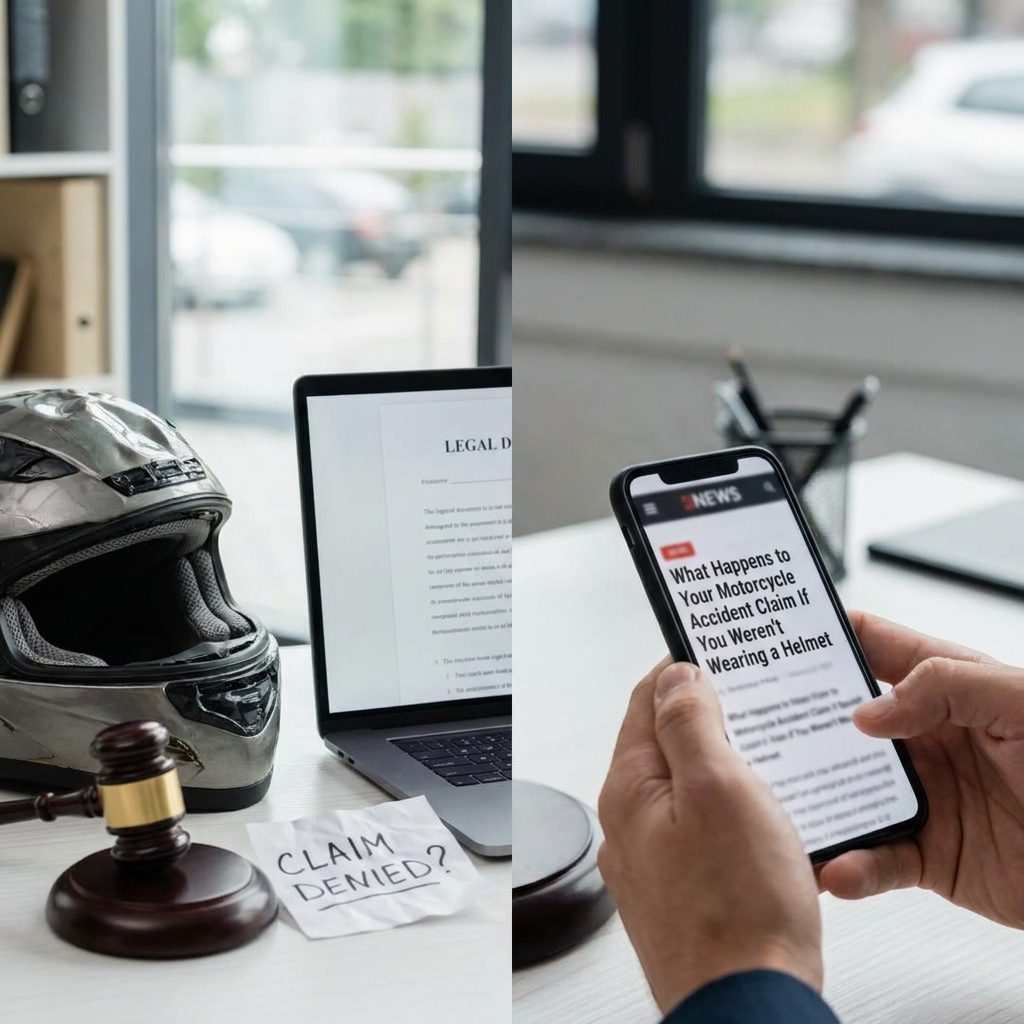
What Happens to Your Motorcycle Accident Claim If You Weren’t Wearing a Helmet
If you were injured in a motorcycle accident and you weren’t wearing a helmet, there is a good chance you’ve already told yourself — or been told by someone else — that you don’t have a case. That the absence of a helmet means you assumed the risk, that you were asking for what happened, that no attorney will touch your claim, or that the other driver’s insurance company will simply point to your bare head and walk away.
This is one of the most persistent and most damaging myths in motorcycle accident law. And like most myths that cost injured people real money, it has just enough surface plausibility to be convincing.
The truth is more nuanced, more jurisdiction-specific, and considerably more favorable to injured riders than the myth suggests. Whether you were wearing a helmet at the time of your accident affects your claim in specific, legal ways that depend on the state where the accident occurred, the nature of your injuries, and how the facts of the crash actually played out. It does not automatically eliminate your right to recover compensation — and in many cases, its effect is far more limited than you’ve been led to believe.
This article explains exactly what happens to a motorcycle accident claim when the rider wasn’t wearing a helmet, state by state framework, and what you can do to protect your recovery.
The foundational question: helmet laws vary dramatically by state
The first thing to understand is that helmet laws in the United States are not uniform. They vary significantly from state to state, and the legal status of helmet use in the state where your accident occurred is the starting point for any analysis of how it affects your claim.
Some states — including California, New York, and a majority of others — have universal helmet laws that require all motorcycle riders to wear helmets regardless of age. In these states, not wearing a helmet was a violation of state law at the time of your accident, which creates a specific legal dynamic discussed below.
Other states have partial helmet laws that require helmets only for riders under a certain age — typically eighteen or twenty-one — while allowing adult riders to ride without one. In these states, if you were an adult rider without a helmet, you were operating within the law, which significantly limits the other side’s ability to use the absence of a helmet against you.
A small number of states have no mandatory helmet law at all for adult riders. In those states, choosing not to wear a helmet was an entirely legal decision, and the argument that your choice contributed to your injuries is substantially weaker.
Knowing which category your state falls into is the essential first step in understanding how the helmet issue affects your specific claim.
What the insurance company will argue
Regardless of which state you’re in, if you weren’t wearing a helmet when you were injured, expect the other driver’s insurance company to make the helmet argument. It is one of the most reliable tools in the defense playbook for motorcycle accident cases, and they use it aggressively.
The argument takes one of two forms depending on the state. In states with universal helmet laws, the argument is that you violated the law by not wearing a helmet, and that this violation constitutes negligence per se — meaning negligence established by the very fact of the legal violation — which contributed to your injuries and should reduce your recovery. In states without universal helmet laws, or where adult riding without a helmet is legal, the argument shifts to one of contributory negligence — that a reasonable person in your position would have worn a helmet regardless of legal requirement, and that your failure to do so was unreasonable conduct that contributed to your harm.
Both versions of this argument share the same ultimate goal: to establish that you bear some percentage of fault for your own injuries, which under comparative fault principles reduces the amount the insurance company has to pay.
The critical legal distinction: causation
Here is where the helmet argument runs into a significant legal limitation that the insurance company will not volunteer to explain to you.
The legal relevance of not wearing a helmet is not unlimited. It is constrained by the principle of causation — specifically, by whether the absence of a helmet actually caused or contributed to the injuries you suffered. This distinction matters enormously in practice.
If your injuries are head injuries — traumatic brain injury, skull fracture, facial trauma — the argument that a helmet would have prevented or reduced those injuries has genuine legal traction. A properly worn helmet is designed to absorb and distribute the energy of a head impact. If your head struck the pavement or another vehicle and you suffered the kinds of injuries a helmet is designed to prevent, the defense can make a reasonable argument that the absence of a helmet contributed to the severity of those injuries.
But if your injuries have nothing to do with your head — a broken leg, a shattered pelvis, spinal injuries, internal organ damage, road rash on your arms and torso — the absence of a helmet is legally irrelevant to those injuries. A helmet protects your head. It does not protect your legs, your spine, your internal organs, or the rest of your body. An insurance company that tries to use the absence of a helmet to reduce compensation for a broken femur is making a legally unsound argument, and an experienced attorney will push back on it effectively.
This is why the specific nature of your injuries matters so much when evaluating how the helmet issue affects your claim. It is not a blanket reduction applied to everything. It is an argument that must be connected to the injuries it supposedly caused — and that connection only holds for a specific category of harm.
How comparative fault operates in practice
In states that apply comparative fault — which is the majority — the helmet issue, where it is legally relevant, typically manifests as a percentage of fault attributed to the injured rider. That percentage then reduces the total damages recovery proportionally.
The specific percentage attributed is not predetermined by law. It is a factual question — sometimes decided by a jury, sometimes negotiated between the parties — that depends on how strongly the evidence connects the absence of a helmet to the injuries suffered, how clear the other driver’s fault was, and how effectively your attorney argues against an inflated fault attribution.
A finding that you were ten percent at fault for not wearing a helmet means your recovery is reduced by ten percent. A finding of twenty-five percent means a twenty-five percent reduction. How aggressively and how effectively that percentage is contested often comes down to the quality of your legal representation and the strength of the medical and expert evidence connecting — or failing to connect — the helmet absence to your specific injuries.
In states that use modified comparative fault with a fifty or fifty-one percent threshold, the helmet argument theoretically could eliminate recovery if you were found more than half at fault. In practice, this outcome is extremely rare in cases where another driver’s negligence was the primary cause of the crash — the helmet absence is a contributing factor argument, not a causation argument, and attributing majority fault to a rider for not wearing a helmet when someone else caused the accident is a very difficult case for the defense to make.
What you should not do
When you are aware that you weren’t wearing a helmet at the time of your accident, the temptation may be to either say nothing about it or to shape your account of the accident in ways that minimize its significance. Both approaches are mistakes.
The absence of a helmet is typically visible in accident scene photographs, documented in the police report, and noted in emergency medical records. Attempting to minimize or obscure it is not only ineffective — it damages your credibility on everything else. The factual record is what it is, and the strategy for dealing with it is not concealment but rather a well-prepared legal argument about its limited legal relevance to your specific injuries.
The stronger argument: the other driver caused the accident
Here is the point that gets lost when injured riders focus too much on the helmet issue: the question of whether you were wearing a helmet is entirely separate from the question of who caused the accident. Those are two different inquiries, and the second one matters far more.
If the other driver ran a red light, made an illegal left turn, was texting, was drunk, was speeding, or otherwise failed to operate their vehicle with reasonable care and that failure caused the collision — that driver is at fault for the crash. The absence of your helmet does not change that. It does not transfer fault for the accident itself from the driver who caused it to the rider who wasn’t wearing a helmet. It is relevant, at most, to the severity of certain specific injuries — not to the question of who bears responsibility for the collision.
An experienced motorcycle accident attorney approaches the case by building the strongest possible liability case against the at-fault driver first, and then addressing the helmet issue in its proper limited context — as a damages argument with specific legal boundaries, not as a case-destroying admission.
Practical steps to protect your claim
If you were in a motorcycle accident without a helmet and you haven’t yet spoken with an attorney, a few things are worth doing immediately regardless of where you are in the process.
Document your injuries thoroughly with photographs taken as early as possible and regularly as healing progresses. Obtain your medical records and review them to understand exactly what injuries are documented and how they are described. Do not give a recorded statement to the other driver’s insurance company before consulting an attorney — this is true in every motorcycle accident case, and it is particularly true when the helmet issue is present, because the questions asked in a recorded statement are often designed to elicit admissions that maximize the legal relevance of the missing helmet.
And do not accept any settlement offer before the full scope of your injuries is understood and before you have had your specific situation evaluated by an attorney who knows your state’s law. The insurance company’s first offer in a case involving an unhelmeted rider is almost certainly discounted well beyond what the helmet issue legally justifies — and that discount comes directly out of your pocket.
If you were injured in a motorcycle accident and you’re concerned about how not wearing a helmet might affect your claim, I want to hear from you. I’m Jelani Aitch, a personal injury attorney. Contact me directly through this website and I’ll personally reach out, hear what happened, and tell you exactly where you stand — no matter where in the United States it happened.