

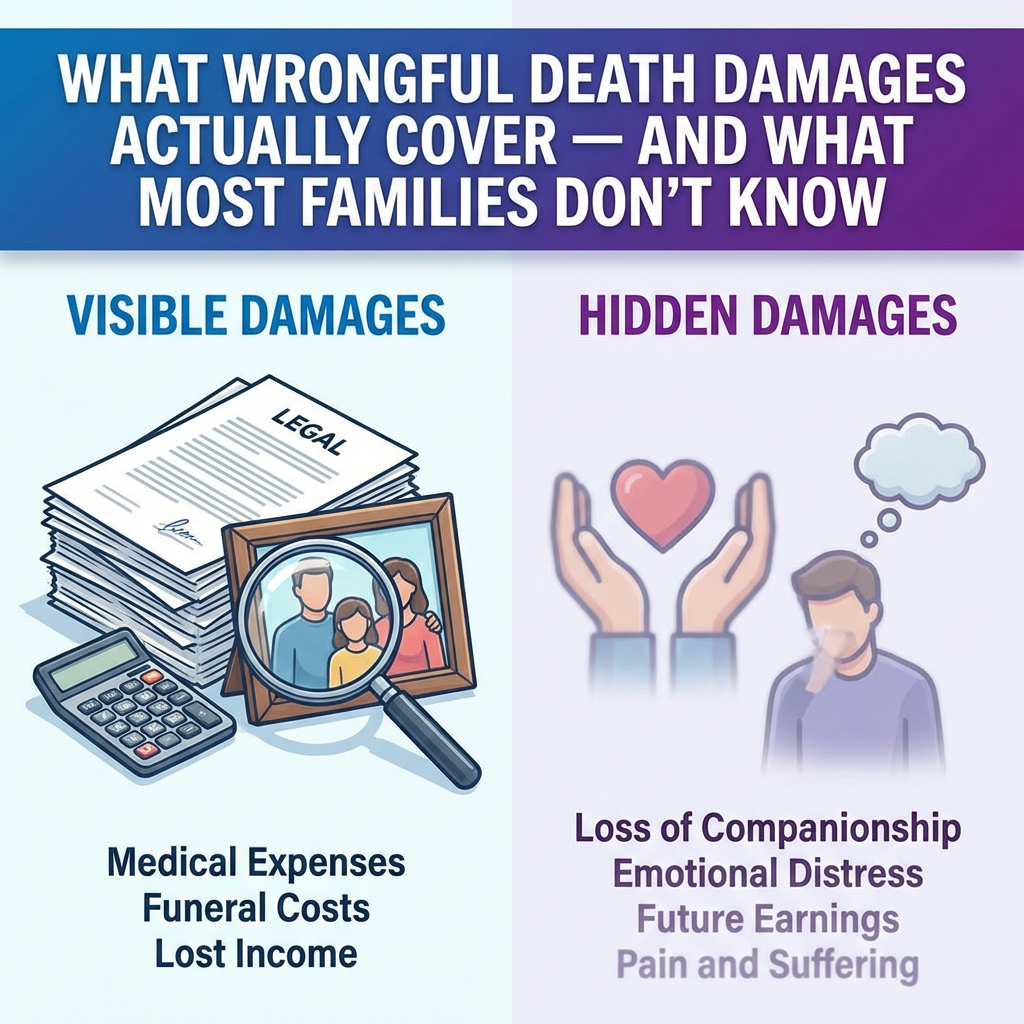
What Wrongful Death Damages Actually Cover — And What Most Families Don’t Know
There is no legal process more emotionally difficult than a wrongful death claim. You have lost someone — a spouse, a parent, a child, a sibling — because of another person’s carelessness, recklessness, or deliberate disregard for safety. You are grieving. You are likely dealing with financial consequences that arrived without warning. And somewhere in the background, there is a legal system that offers a mechanism for accountability and compensation that most families know almost nothing about.
The gap between what families believe a wrongful death claim can recover and what it can actually recover is significant. Most people, when they think about wrongful death compensation at all, think about funeral costs and maybe some lost income. The reality is considerably broader than that — and understanding the full scope of what the law allows is the first step toward making an informed decision about whether and how to pursue a claim.
This article is a complete, plain-language explanation of what wrongful death damages actually cover, how they are calculated, what most families don’t know going in, and what affects the ultimate value of a claim. It is not a substitute for legal advice specific to your situation. But it is information that every family in this position deserves to have.
The two categories of wrongful death damages
Wrongful death damages in most states fall into two broad categories: economic damages and non-economic damages. Some states also permit a third category — punitive damages — under specific circumstances. Understanding what lives in each category is the foundation for understanding what a wrongful death claim can actually recover.
Economic damages are the financial losses that can be calculated with relative precision. They are grounded in numbers — income figures, medical bills, actuarial tables, expert projections. Non-economic damages are the losses that don’t appear on a balance sheet but are no less real — the loss of a parent’s guidance, a spouse’s companionship, a provider’s presence. Both categories are legally recognized. Both are compensable. And in serious wrongful death cases, the non-economic damages are often the larger of the two.
Economic damages: what they include and how they are calculated
Funeral and burial expenses. These are typically the first costs families think of, and they are recoverable in virtually every wrongful death case. Funeral costs in the United States average several thousand dollars and can run significantly higher depending on circumstances. These expenses are documented and reimbursable as part of the claim.
Medical expenses incurred before death. If your loved one survived the incident that ultimately caused their death — even briefly — there are almost certainly medical bills associated with that survival period. Emergency room treatment, surgery, intensive care, transportation by ambulance or air — all of these costs are recoverable as part of the wrongful death claim. In cases where someone survived for days, weeks, or longer before dying from their injuries, these bills can be substantial.
Lost income and lost earning capacity. This is typically the largest economic component of a wrongful death claim, and it is also the most complex to calculate. The question being answered is: what would this person have earned over the remainder of their working life, had they not been killed?
The calculation starts with the deceased’s actual income at the time of death — their salary, wages, self-employment income, bonuses, benefits, and other compensation. It then projects that income forward over their expected remaining working years, accounting for reasonable assumptions about raises, career progression, and inflation. It applies actuarial data about life expectancy. And it discounts the projected future earnings to present value — a technical calculation that accounts for the fact that a dollar received today is worth more than a dollar received ten years from now.
For high earners, for people with strong career trajectories, and for younger victims with decades of earning potential ahead of them, this calculation can produce very large numbers. For someone who was retired, who was not employed outside the home, or who had limited documented income, the calculation is more complex but still meaningful — particularly when the next category is factored in.
The value of household services. This is one of the most commonly overlooked components of economic damages, and it is one that insurance companies are very happy for families not to think about.
Every person in a household provides services that have real economic value — cooking, cleaning, childcare, yard work, home maintenance, driving, financial management, elder care. When that person dies, those services either go unprovided or must be replaced at market rates. The economic value of those services over a projected lifetime is a legitimate and calculable component of wrongful death damages.
This category is particularly important in cases involving stay-at-home parents or spouses whose income may have been limited but whose contribution to the household was substantial. Expert witnesses — economists and vocational specialists — are frequently called to quantify these losses.
Lost benefits. Health insurance, retirement contributions, pension benefits, stock options, and other employment-related benefits that the deceased would have provided to the family are also recoverable. These are often significant, particularly when the deceased was the primary carrier of family health insurance or was approaching retirement with a substantial pension.
Non-economic damages: what they include and why they matter
Non-economic damages are, in many wrongful death cases, the most significant component of the total claim. They are also the most frequently misunderstood — both in terms of what they include and in terms of how they are valued.
Loss of companionship and consortium. A surviving spouse who loses their partner loses more than an income source. They lose the daily presence of the person they built their life with — their companionship, their emotional support, their intimacy, their partnership in every dimension of life. The law recognizes this loss as real and compensable. Loss of consortium damages are available to surviving spouses in most jurisdictions and can be substantial.
Loss of parental guidance and nurturing. When a parent is killed, surviving minor children lose something that cannot be replaced and cannot be purchased: the guidance, nurturing, teaching, and presence of their parent through childhood and adolescence and beyond. The law recognizes this loss explicitly. Expert testimony — from child psychologists, family therapists, and other specialists — is often used to articulate the scope and permanence of what children lose when a parent dies prematurely and wrongfully.
Loss of support and society. Beyond the specific relationships of spouse and parent-child, wrongful death statutes typically recognize a broader category of loss — the loss of the deceased’s presence, support, and participation in the lives of those who loved them. This category can extend to adult children who lose a parent, to parents who lose an adult child, and to other family members depending on the state’s wrongful death statute.
Grief and mental anguish. Some states permit recovery for the grief, sorrow, and mental anguish that surviving family members experience as a result of their loss. This is distinct from the relational losses described above — it is the emotional suffering of bereavement itself. Not all states recognize this as a separate compensable item, but many do, and in those that do, it can be a meaningful component of the damages.
Survival damages: a separate but related category
In addition to wrongful death damages — which belong to the survivors — most states also recognize what are called survival damages, which belong to the deceased person’s estate.
Survival damages represent the losses the deceased person themselves experienced between the time of the injury and the time of death. This includes the pain and suffering they endured, any lost income during that period, and other personal losses. In cases where the deceased survived for a period of time before dying — even hours or days — survival damages can be significant and are pursued alongside the wrongful death claim.
The distinction matters because survival damages and wrongful death damages are often pursued together but are technically separate legal actions. An attorney handling a wrongful death case will typically evaluate both and pursue whichever applies to the circumstances.
Punitive damages: when they apply and what they mean
In most wrongful death cases, the damages described above are the full scope of what is available. But in cases involving conduct that goes beyond ordinary negligence — conduct that is grossly reckless, willful, or intentionally harmful — some states permit an additional category of damages called punitive damages.
Punitive damages are not designed to compensate the family for their loss. They are designed to punish the defendant for particularly egregious conduct and to deter similar conduct in the future. Drunk driving deaths, deaths caused by companies that knowingly concealed safety defects, deaths resulting from reckless disregard for the safety of others — these are the kinds of circumstances where punitive damages may be available.
Not every state permits punitive damages in wrongful death cases, and in those that do, the standard for awarding them is high. But in appropriate cases, they can dramatically increase the total value of a claim and send a powerful message about the consequences of egregious conduct.
What affects the value of a wrongful death claim
Understanding what wrongful death damages cover is the first step. Understanding what affects the ultimate value of a specific claim is the second.
The age of the deceased matters significantly, because it affects the projected earning period and the duration of relational losses. A 35-year-old with young children and decades of career ahead represents a different economic calculation than a 70-year-old who had retired.
The income and career trajectory of the deceased matters because lost earnings are calculated forward from their actual financial situation. Higher earners, professionals with strong trajectories, and business owners with demonstrable income histories all have larger economic damage calculations.
The number and ages of surviving dependents matters because more dependents, particularly young children, means more people who have suffered relational losses over a longer projected period.
The strength of the liability case matters because damages don’t exist in a vacuum — they are recovered from a defendant who is found to be responsible. A clear liability case, with strong evidence of the defendant’s fault, supports a larger recovery than a case where liability is contested or where comparative fault arguments are available to the defense.
The state where the case is filed matters because wrongful death law varies by state. Caps on non-economic damages, available categories of damages, and who has standing to bring the claim all depend on which state’s law governs.
What families are most often surprised to learn
In the years of handling these cases, the things that most consistently surprise families are these: how broad the damages actually are beyond funeral costs and lost wages, how significant the non-economic damages can be when properly developed and presented, how important it is to have expert witnesses who can quantify losses that aren’t obvious from a pay stub, and how much the quality of legal representation affects the ultimate outcome.
A wrongful death case is not a form you fill out and submit. It is a complex legal matter that requires thorough investigation, expert analysis, and experienced advocacy. The difference between a claim handled by an attorney who genuinely understands wrongful death law and one handled by someone who doesn’t is often measured in hundreds of thousands of dollars — sometimes more.
Your family deserves to know what you are actually entitled to. Not a partial picture. Not what the insurance company chooses to tell you. The full picture, from someone who is on your side.
If you lost someone because of another person’s negligence and you want to understand what your family may actually be entitled to recover, please don’t navigate this alone. I’m Jelani Aitch, a personal injury attorney. Reach out through this website and I’ll personally learn the details of your situation and help you understand what your case may actually be worth — no matter where in the United States it happened.