

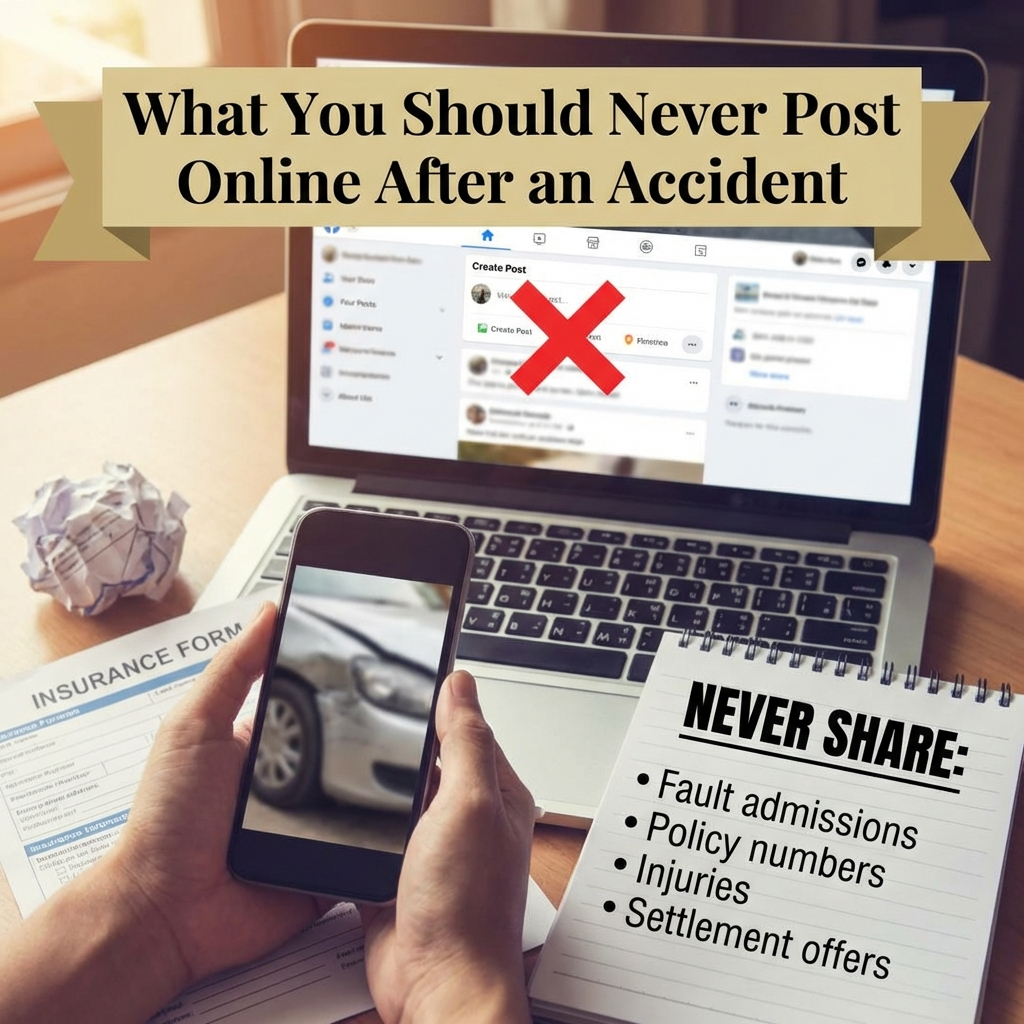
What You Should Never Post Online After an Accident
After an accident, most people don’t think social media has anything to do with their injury claim.
They’re focused on:
-
getting their car repaired
-
dealing with pain
-
figuring out medical care
-
talking to insurance
-
getting back to work
So when they post something online, it’s usually innocent.
A quick update.
A photo.
A joke.
A “glad I’m okay” message.
But here’s the truth most people don’t learn until it’s too late:
Social media is one of the easiest ways to damage an otherwise strong injury claim.
And the most dangerous part is that you usually don’t even realize you’ve done it.
This article explains what you should never post online after an accident, why insurance companies care so much, and how to protect yourself without feeling paranoid.
Social Media Isn’t “Private” After an Accident
A lot of people assume:
-
“My account is private.”
-
“I’m only posting for friends.”
-
“No one will see this.”
-
“I’m not doing anything wrong.”
But injury claims aren’t evaluated based on what feels private. They’re evaluated based on what can be found, saved, and used.
Insurance companies and defense attorneys may attempt to view social media content in several ways, including:
-
public posts
-
tagged photos
-
public comments
-
stories and reels
-
profile activity
-
friends’ posts that include you
-
posts you are tagged in
Even if your account is private, it’s a mistake to assume nothing can surface.
The safest mindset after an accident is simple:
If it’s online, assume it could eventually be seen.
Why Social Media Matters So Much in Injury Claims
Insurance companies don’t just evaluate injuries. They evaluate credibility.
They ask:
-
Is this person really hurt?
-
Are they exaggerating?
-
Are their medical complaints consistent?
-
Do their activities match their reported limitations?
Social media is valuable to insurers because it can be used to suggest:
-
you’re not as injured as you claim
-
your pain isn’t serious
-
you recovered faster than the medical records suggest
-
you’re physically active despite restrictions
Even if those conclusions are unfair or misleading, they can still impact claim value.
And once a post exists, you can’t control how it will be interpreted.
The Biggest Mistake: Posting “I’m Fine”
One of the most common posts people make after an accident is something like:
-
“I’m okay, just shaken up.”
-
“I’m fine.”
-
“Could’ve been worse.”
-
“Everyone’s okay.”
Most people post this because they don’t want loved ones to worry.
But in an injury claim, this is dangerous.
Why?
Because pain and symptoms often develop later.
As you already know from the injury side of the process:
-
whiplash is delayed
-
back pain often worsens
-
concussion symptoms can appear later
-
soreness can become disabling
Insurance companies love early statements like “I’m fine” because they can argue:
-
you weren’t injured
-
you changed your story
-
symptoms developed later and are unrelated
Even if the injury is real, early “I’m fine” posts create unnecessary doubt.
What You Should Never Post After an Accident
Let’s break this down clearly.
These are the categories of posts that routinely damage injury claims.
1. Photos of You Looking Happy or Normal
This is one of the most common and most unfair issues.
You can be injured and still:
-
smile
-
attend an event
-
be outside
-
appear normal in a photo
But insurance companies often use photos to suggest:
-
you’re not suffering
-
you’re exaggerating
-
you’re fully recovered
Even a simple photo at dinner can be framed as:
“Look, they’re out living normally.”
This is why accident victims are often advised to avoid posting photos of themselves during the claim period.
2. Videos of Physical Activity
This is the most dangerous category.
If you are claiming:
-
back pain
-
neck pain
-
shoulder pain
-
concussion symptoms
-
limitations on lifting or movement
and you post a video of:
-
working out
-
dancing
-
lifting something
-
hiking
-
playing sports
-
moving furniture
-
even vigorous cleaning
it can be used to challenge your entire claim.
Even if you felt okay for one moment, or pushed through pain, a video becomes a permanent “snapshot” insurers can weaponize.
3. Updates About the Accident
Avoid posting:
-
who caused the crash
-
what happened
-
who was “at fault”
-
how fast someone was going
-
whether you were distracted
-
any details that could be misinterpreted
Even if you are correct, your post becomes evidence.
And posts can be used to create inconsistencies later if your memory evolves or if additional facts emerge.
The safest approach is:
Don’t narrate your accident online.
4. Complaints About Pain or Injuries
This one surprises people.
You might think posting about pain helps your claim.
But it can actually backfire.
Why?
Because insurers may argue:
-
you’re exaggerating publicly
-
you’re trying to build a narrative
-
your complaints are inconsistent with medical records
Also, once you post about symptoms online, it can become a reference point that insurers compare to your medical records.
Your medical documentation should be handled through medical providers — not social media.
5. Comments About “Lawyering Up”
Avoid posting things like:
-
“Time to sue.”
-
“I’m about to get paid.”
-
“This guy is going to regret it.”
-
“Lawyer time.”
Even if you’re joking, these posts can be used to suggest:
-
your motivation is money
-
you’re not genuinely injured
-
you’re pursuing a claim for the wrong reasons
This is one of the easiest ways to damage credibility.
6. Posts About Drinking, Parties, or Vacations
Even if unrelated, these posts can be used to argue:
-
you’re not suffering
-
you’re not limited
-
your injury isn’t serious
-
you’re living normally
Again, this is not fair — but it is common.
7. Deleting Posts (Yes, Even Deleting Can Be Risky)
Many people panic and start deleting posts after they realize social media could matter.
But deletion can create a different problem.
If a claim becomes litigated, deletion can raise questions about:
-
whether evidence was destroyed
-
whether something was intentionally hidden
This is why the safest strategy is:
-
stop posting
-
tighten privacy settings
-
avoid creating new content
If you are concerned about existing posts, it’s better to get guidance before mass deletion.
What About Posts From Friends and Family?
This is another overlooked issue.
Even if you don’t post anything, your friends may post:
-
group photos
-
event pictures
-
tags
-
comments like “glad you’re okay!”
Those posts can still create an impression that:
-
you are active
-
you are not limited
-
you recovered quickly
After an accident, it’s smart to:
-
ask close friends not to tag you
-
review tag settings
-
avoid being included in public posts
The Core Issue: Insurance Companies Look for Contradictions
This connects directly to the broader documentation theme.
Insurance companies don’t need to prove you’re lying.
They just need to find something that looks inconsistent.
Social media creates an endless supply of content that can be taken out of context.
That’s why it’s one of the easiest ways to weaken a claim.
How This Fits Into the Bigger “After an Accident” Strategy
Social media mistakes are part of the broader set of early errors people make after accidents.
If you want the full roadmap of what to do after a crash — including medical care, documentation, police reports, and dealing with insurance — see:
➡️ What to Do After an Accident
And if you want related reading on documentation mistakes, these two posts pair perfectly with this one:
-
How Poor Documentation Destroys Otherwise Strong Claims
-
Why Insurance Companies Love Gaps in Medical Treatment
The Takeaway
After an accident, social media can quietly damage an injury claim even when:
-
the injury is real
-
the person is honest
-
the accident wasn’t their fault
The safest approach is simple:
Don’t post about the accident. Don’t post about your injuries. Don’t post anything that could be misinterpreted as physical capability.
It’s not about paranoia.
It’s about protecting yourself from a system that evaluates claims through documentation and credibility — not through what feels fair.