

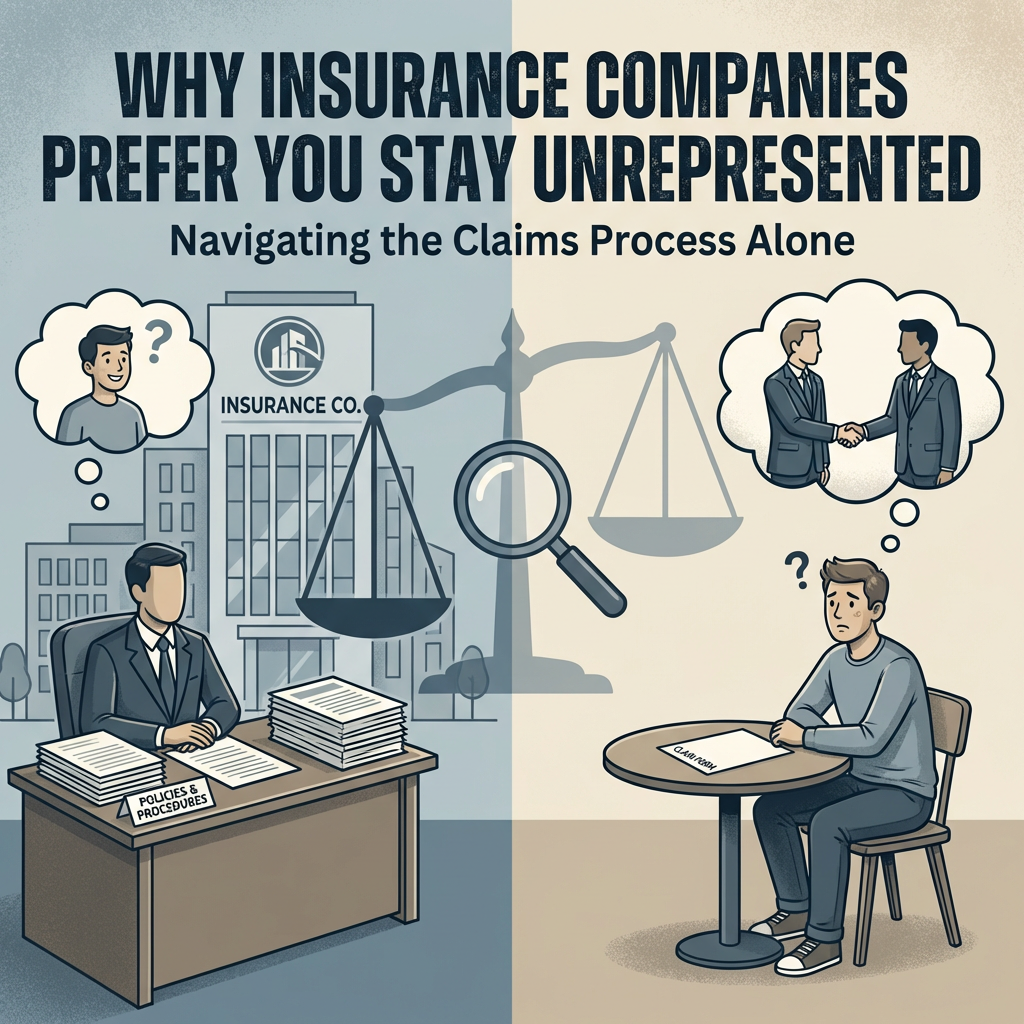
Why Insurance Companies Prefer You Stay Unrepresented
After a car accident, one of the first questions many people ask is:
“Do I really need a lawyer?”
Insurance companies know that question is coming.
And in many cases, they prefer that the answer be no.
This isn’t personal.
It isn’t emotional.
It’s structural.
Insurance companies are businesses built around risk management. And from a risk perspective, unrepresented claimants are generally easier to evaluate, negotiate with, and settle.
Understanding why insurers often prefer you stay unrepresented helps clarify how leverage works in injury claims.
The Structural Advantage of Unrepresented Claims
When someone handles their own claim, the insurance company knows several things immediately:
-
There may be limited knowledge of claim valuation.
-
Documentation may not be strategically organized.
-
Deadlines may not be fully understood.
-
Negotiation posture may be softer.
-
Litigation risk may be lower.
That doesn’t mean unrepresented people are incapable.
It means the risk profile changes.
Insurance companies price claims based on exposure — and exposure includes legal risk.
Litigation Risk Drives Settlement Value
One of the most important (and least understood) valuation drivers in injury claims is litigation risk.
Insurance companies evaluate:
-
How likely the case is to go to court.
-
Whether the lawyer has trial experience.
-
The cost of defending the claim.
-
Jury unpredictability.
-
Venue risk.
-
Defense expenses.
When someone is unrepresented, the probability of litigation typically decreases.
Lower litigation risk = lower exposure.
Lower exposure often translates to lower settlement range.
As discussed in How Insurance Companies Decide What Your Case Is Worth, risk evaluation is central to valuation.
Legal representation changes that equation.
Information Asymmetry
Insurance companies handle thousands of claims.
Most injured individuals handle one.
That creates information asymmetry.
Insurers understand:
-
Medical billing structures
-
Typical treatment timelines
-
Standard settlement ranges
-
Documentation weaknesses
-
Common mistakes
-
Internal reserve calculations
In my experience reviewing how claims unfold, one of the most common patterns is this:
Unrepresented claimants often focus on medical bills alone.
Insurance companies evaluate much more than bills.
They assess:
-
Future care risk
-
Pain duration
-
Work impact
-
Causation strength
-
Credibility factors
-
Surveillance risk
-
IME potential
Without understanding that full framework, negotiation leverage is limited.
Early Settlement Dynamics
Insurance companies often move quickly when someone is unrepresented.
They may:
-
Request a recorded statement early.
-
Make an early settlement offer.
-
Emphasize fast resolution.
-
Highlight simplicity.
-
Suggest avoiding “legal complications.”
Early offers can feel efficient.
But efficiency and adequacy are not the same.
As outlined in Why Early Settlement Offers Are Almost Always Too Low, early offers frequently occur before the full medical picture develops.
Once a settlement is signed, future claims typically cannot be reopened.
Recorded Statements and Unrepresented Claims
Recorded statements are more common — and often more aggressive — when someone is unrepresented.
Adjusters may:
-
Ask detailed causation questions.
-
Explore prior medical history.
-
Clarify symptom onset timing.
-
Probe for inconsistencies.
Without legal guidance, it’s easy to unintentionally minimize injuries or provide statements that later complicate causation.
Insurance companies are trained to evaluate language carefully.
Unrepresented claimants may not realize how statements are later analyzed.
Documentation Organization
When a lawyer is involved, documentation is typically:
-
Collected systematically.
-
Reviewed for consistency.
-
Organized chronologically.
-
Evaluated for causation clarity.
-
Prepared strategically.
Without that structure, records may:
-
Arrive incomplete.
-
Contain inconsistencies.
-
Include treatment gaps.
-
Lack clarifying medical opinions.
Documentation strength influences settlement value directly.
Negotiation Posture
Negotiation is not simply a discussion about numbers.
It’s an evaluation of risk.
When insurers believe:
-
The claimant may accept less.
-
Litigation is unlikely.
-
Legal escalation is minimal.
-
Deadlines are flexible.
-
Pressure is low.
Settlement posture often reflects that perception.
Representation shifts posture.
Not because of hostility — but because of altered risk.
Why Insurance Companies Rarely Suggest You Hire a Lawyer
Insurance companies are not required to recommend legal representation.
In fact, most will:
-
Emphasize cooperative resolution.
-
Suggest claims are straightforward.
-
Encourage direct communication.
-
Present themselves as helpful guides.
Many adjusters are professional and polite.
But politeness does not equal advocacy.
Insurance companies represent the insurer.
They do not represent the injured party.
When Unrepresented Claims Still Resolve Fairly
It’s important to acknowledge something clearly:
Some unrepresented claims resolve reasonably.
Particularly when:
-
Liability is clear.
-
Injuries are minor.
-
Treatment is brief.
-
Bills are limited.
-
No long-term impairment exists.
But as complexity increases — causation disputes, disc involvement, extended treatment, surveillance, IMEs — exposure increases.
And so does scrutiny.
Why Representation Changes Claim Dynamics
When legal representation enters a claim, insurers must evaluate:
-
Litigation probability.
-
Trial history.
-
Settlement posture.
-
Defense cost.
-
Time horizon.
-
Jury risk.
-
Public exposure.
That shifts the internal reserve calculation.
Reserve changes influence negotiation flexibility.
This is not emotional.
It’s actuarial.
The Experience Layer
In reviewing claim patterns over time, one consistent dynamic emerges:
Claims with similar injuries can resolve at significantly different ranges depending on how leverage is structured.
Representation often changes that structure.
Not always dramatically.
But structurally.
And structural changes affect risk evaluation.
The Bigger Perspective
Insurance companies do not prefer unrepresented claimants because they dislike lawyers.
They prefer them because:
-
Litigation risk is lower.
-
Documentation may be weaker.
-
Negotiation pressure is reduced.
-
Reserve exposure is smaller.
-
Escalation likelihood declines.
From a business standpoint, that preference makes sense.
Understanding that preference helps clarify how leverage works in injury claims.
The Takeaway
Insurance companies often prefer you stay unrepresented because:
-
Litigation risk decreases.
-
Information asymmetry increases.
-
Documentation structure may weaken.
-
Early settlement becomes more likely.
-
Negotiation pressure lowers.
-
Exposure becomes easier to manage.
That does not mean every case requires representation.
But it does mean representation changes the evaluation equation.
In injury claims, settlement value is rarely determined by injury alone.
It is determined by injury plus risk.
And risk changes when leverage changes.