

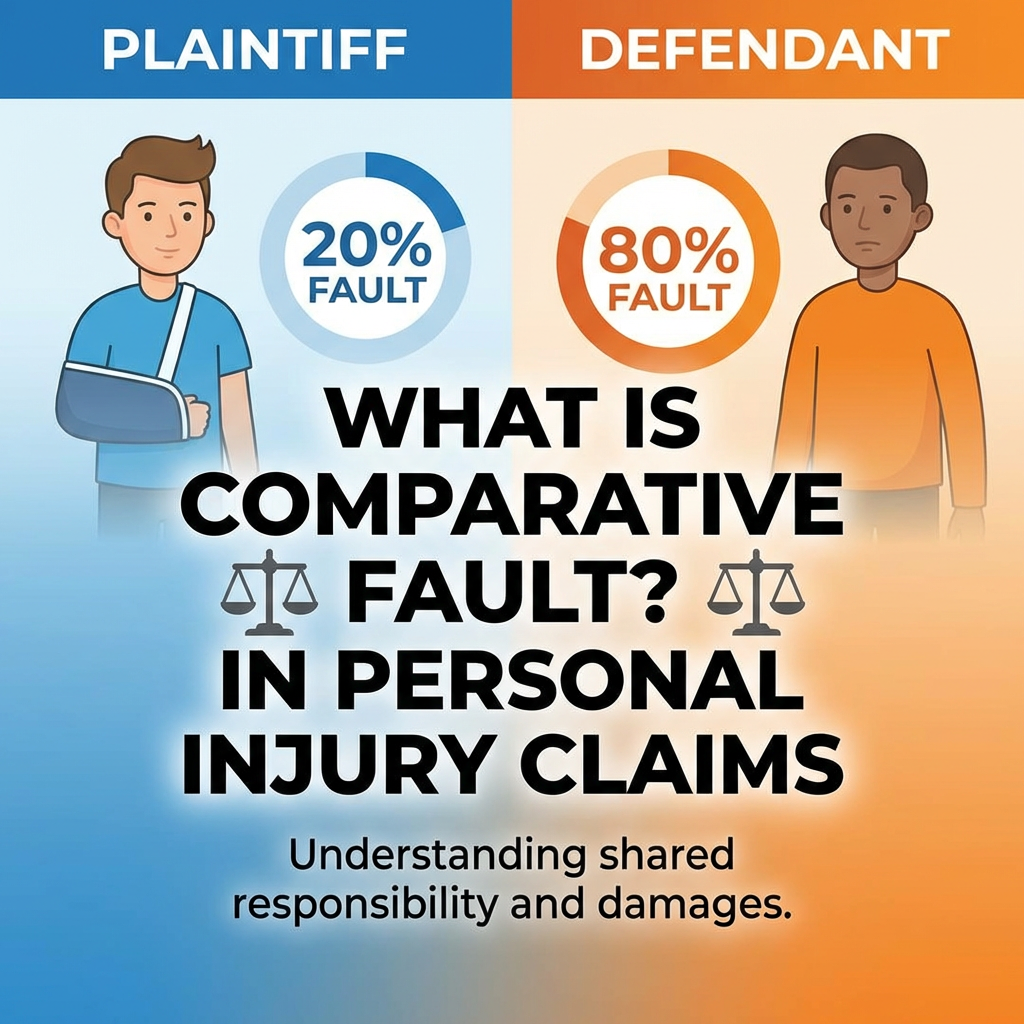
What Is Comparative Fault in Personal Injury Claims?
After a car accident, determining who caused the crash is often one of the most important parts of the insurance claim process.
In some accidents, fault is relatively clear. For example, a driver who runs a red light or rear-ends another vehicle may be considered responsible for the collision.
However, many accidents are not that simple.
Sometimes both drivers may have contributed in some way to the events that led to the crash. When this happens, the law in many states applies a concept known as comparative fault.
Comparative fault plays an important role in personal injury claims because it affects how responsibility for the accident is assigned and how compensation may be evaluated.
Understanding how comparative fault works can help clarify why insurance companies sometimes dispute accident claims.
What Comparative Fault Means
Comparative fault refers to a legal principle used to allocate responsibility when more than one party contributed to an accident.
Instead of assigning 100 percent responsibility to a single driver, comparative fault allows responsibility to be divided among multiple parties based on their level of involvement in the accident.
For example, investigators may determine that:
-
one driver was primarily responsible for the crash
-
the other driver contributed in a smaller way
In these situations, fault may be expressed as percentages that reflect each party’s role in the accident.
This allocation of responsibility can influence how injury claims are evaluated.
Why Comparative Fault Exists
Comparative fault exists because many accidents occur due to a combination of factors rather than a single mistake.
For example, one driver may have been speeding while another driver failed to yield at an intersection.
Both actions may have contributed to the collision.
Comparative fault allows investigators and courts to recognize that responsibility for an accident may sometimes be shared between drivers.
This approach can provide a more balanced evaluation of how the accident occurred.
How Insurance Companies Evaluate Fault
Insurance companies usually conduct investigations to determine how an accident occurred and who may have been responsible.
These investigations often involve reviewing several types of evidence, including:
-
police reports
-
photographs from the accident scene
-
witness statements
-
vehicle damage patterns
-
traffic camera footage
By analyzing this evidence, insurers attempt to determine whether one driver was fully responsible or whether both drivers contributed to the crash.
As explained in How Insurance Companies Evaluate Evidence in Injury Claims, insurers often compare multiple forms of documentation when determining liability.
Examples of Comparative Fault
Comparative fault can arise in many different accident scenarios.
Some examples include:
Intersection Accidents
One driver may fail to yield while another driver is speeding.
Investigators may determine that both actions contributed to the collision.
Lane Change Accidents
A driver may attempt to change lanes without checking blind spots while another vehicle is traveling slightly above the speed limit.
In some cases, both drivers may be considered partially responsible.
Rear-End Collisions
Rear-end accidents are often attributed to the trailing driver. However, there may be situations where the leading driver contributed to the accident, such as stopping abruptly in an unsafe location.
Because accident circumstances can vary, investigators often review the available evidence carefully when determining fault.
How Fault Percentages Are Determined
When comparative fault is applied, responsibility for the accident may be expressed in percentages.
For example:
-
Driver A may be considered 80 percent responsible
-
Driver B may be considered 20 percent responsible
These percentages reflect the investigator’s assessment of how each driver contributed to the crash.
Insurance companies may use these fault allocations when evaluating claims and determining potential compensation.
Evidence Used in Fault Determinations
Several types of evidence may influence how fault is assigned in an accident.
These include:
-
accident reports prepared by law enforcement
-
witness statements
-
photographs or video footage
-
vehicle damage patterns
-
road conditions and traffic signals
In some cases, insurers may also consult accident reconstruction specialists to analyze how the crash occurred.
When drivers provide conflicting accounts of the accident, investigators often rely heavily on physical evidence and independent witness statements.
Situations involving conflicting accounts are discussed further in What Happens If the At-Fault Driver Lies About the Accident?
Comparative Fault and Insurance Claims
When comparative fault is applied to an accident, it may influence how the insurance claim is evaluated.
Insurance companies may consider the level of responsibility assigned to each party when reviewing the claim.
Because fault determinations can affect how claims are evaluated, liability disputes sometimes arise during the investigation process.
These disputes are discussed in What Happens If an Insurance Company Denies Liability Completely?, which explains how insurers sometimes challenge accident claims.
Why Fault Disputes Occur
Fault disputes may occur when the available evidence does not clearly establish how the accident occurred.
For example, investigators may encounter:
-
conflicting statements from drivers
-
lack of witnesses
-
unclear physical evidence
When evidence is limited, insurers may interpret the available information differently.
This is one reason why accident documentation can play such an important role in personal injury claims.
The Takeaway
Comparative fault is a legal principle used to allocate responsibility when more than one party contributes to an accident.
Instead of assigning all responsibility to a single driver, comparative fault allows investigators and insurers to divide responsibility based on the circumstances of the crash.
Insurance companies often rely on evidence such as accident reports, witness statements, and photographs when determining how responsibility should be assigned.
Understanding how comparative fault works can help clarify why liability disputes sometimes occur during the personal injury claim process.